

How International Healthcare Companies Can Crack the US Mid-Market (Without Burning $100K+)
Entering the US healthcare mid-market is one of the most challenging yet rewarding moves for international healthcare companies. The opportunity is large, the demand for digital transformation is growing, and mid-size providers are actively looking for solutions that improve efficiency, reduce costs, and support clinical operations.
However, the path to winning these customers is rarely straightforward. The US healthcare system is fragmented, procurement cycles are complex, and buyers are cautious when evaluating unfamiliar vendors. Many companies end up spending $100K–$300K before learning what the market actually expects.
The good news: a leaner, more structured approach works.
Below is a practical framework for entering the US mid-market without overspending.
1. Establish Trust Early
For US healthcare buyers, trust is the foundation of every commercial decision. International companies often underestimate how seriously providers evaluate risk when it involves clinical workflows, patient data, or operational systems.
You can build early trust without heavy investment by preparing:
- A clear HIPAA-readiness narrative
- Straightforward documentation on data handling and audit trails
- A simple security and compliance one-pager
- US-specific terminology in technical documents
- An advisory relationship with a US-based healthcare professional
These small but relevant steps help reduce the perceived risk of working with a new, international vendor.
2. Focus Your ICP With Precision
The US healthcare ecosystem is too diverse to approach broadly. Different facility types have different purchasing processes, cost sensitivities, and technical environments. A narrow, well-defined ICP accelerates traction significantly.
Potential starting points include:
- Mid-market hospitals (Example: 150–500 beds)
- Ambulatory surgery centers (ASCs)
- Specialty clinics
- Regional IDNs
With a focused ICP, messaging becomes more relevant, outbound becomes sharper, and product adaptations become more deliberate.
3. Localize Messaging to Reflect US Healthcare Realities
Global case studies and international achievements rarely translate directly to US buyer expectations. What resonates in Europe or Asia may not carry weight in an American clinical or administrative environment.
Effective US localization involves:
- Reframing value using US-centric terminology
- Highlighting workflow improvements familiar to US clinicians
- Referencing US operational pressures (staffing shortages, throughput, reimbursement)
- Incorporating US-specific ROI at the departmental level
Localization signals that your product is built for their environment—not just adapted for it.
4. Leverage Borrowed Credibility Instead of Costly Branding
Instead of large marketing or PR budgets, international companies can accelerate adoption by aligning themselves with trusted voices and organizations already operating in the US.
High-impact trust accelerators include:
- US clinical advisors or champions
- Partnerships with interoperability or integration partners
- A pilot with a credible mid-size provider
- A well-written security whitepaper aligned with US standards
- Mentions in niche healthtech newsletters or podcasts
Borrowed credibility reduces friction and opens doors more efficiently than large-scale brand spending.
5. Prioritize Interoperability and Workflow Compatibility
US mid-market providers expect vendors to integrate smoothly with their existing systems. Even if you have not fully built integrations, demonstrating technical readiness is essential.
Areas to emphasize:
- HL7 and FHIR compatibility
- Clear API documentation
- Logical EHR integration pathways
- Familiar terminology for clinical and administrative workflows
Interoperability is often a prerequisite rather than a differentiator. Companies that address this early significantly shorten sales cycles.
6. Avoid Hiring a US Salesperson Before Market Fit Is Clear
Premature US hiring is one of the most expensive mistakes international companies make. A salesperson cannot compensate for unclear ICP, unrefined messaging, or limited credibility.
Indicators you are not ready to hire:
- No US reference customers
- Limited understanding of US objections
- Inconsistent outbound performance
- Unclear pricing or value positioning
Early-stage US market entry is most efficient when led by founders. Once messaging, ICP, and traction are validated, a US salesperson can add value.
Read more about selling in US.
7. Build a Lean, Targeted Outbound Engine
Outbound remains an effective method for entering the US mid-market, but only when it is tightly focused and aligned with buyer needs.
Effective outbound includes:
- Insight-driven messaging tailored to specific facility types
- A sequence that prioritizes problems over product features
- Clear examples tied to operational efficiency or cost improvement
- Short, direct calls to action
- A targeted list of 500–1,000 ICP-matched prospects
Well-executed outbound creates early conversations without requiring large marketing spend.
8. Target Mid-Market Providers Before Enterprise Systems
Enterprise health systems often have lengthy procurement cycles and complex stakeholder environments. Mid-market providers, on the other hand, tend to move faster, are more open to innovation, and offer excellent early reference potential.
Advantages of starting mid-market:
- Shorter decision cycles
- Greater flexibility with pilots
- Faster feedback loops
- More openness to new vendors
- Lower entry barriers than large IDNs
Mid-market adoption can later unlock enterprise opportunities.
9. Deliver a US-Ready Demo Experience
A strong demo accelerates momentum by demonstrating familiarity with US workflows. Small details matter.
A US-ready demo includes:
- Standard US clinical terminology
- Familiar data formats (units, measurements, coding)
- Clearly identifiable workflow steps
- US-focused examples, forms, dashboards, and metrics
This creates confidence that the product aligns with the buyer’s existing environment.
10. Use Partnerships to Accelerate Entry and Reduce Cost
Partnerships are an effective way for international companies to enter the US without building everything internally. Channel partners, integration firms, consulting groups, and specialty networks can significantly shorten the path to credibility and adoption.
Effective partnerships include:
- EHR ecosystem partners
- Healthcare IT implementation firms
- Regional distributors or resellers
- Boutique consulting groups serving specific specialities
Partnerships provide instant access, market understanding, and downstream credibility.
Conclusion
Cracking the US healthcare mid-market does not require a large budget—it requires clarity, focus, and alignment with how US providers make decisions. Companies that succeed do so by building trust early, narrowing their ICP, localizing their value proposition, and executing a lean go-to-market motion.
The path becomes significantly smoother when credibility is established before selling, outbound efforts are sharply targeted, and partnerships are used strategically. With the right foundation, international companies can enter the US mid-market efficiently and achieve early wins without unnecessary cost.
Check Out Elephant Edge Founder-Led Sales Playbook
Win Your First $1M in US Market

Effective Sales Execution: The Enormous AI Advantage for CEOs of Small Sales Teams
It’s 9 PM and you’re still in the CRM. Following up on a proposal your...

From Chaos to Clarity: 3 Things AI Will Do for SMB Revenue Teams
There’s an awkward stage in the life of an SMB. You’re doing $3 million, maybe...
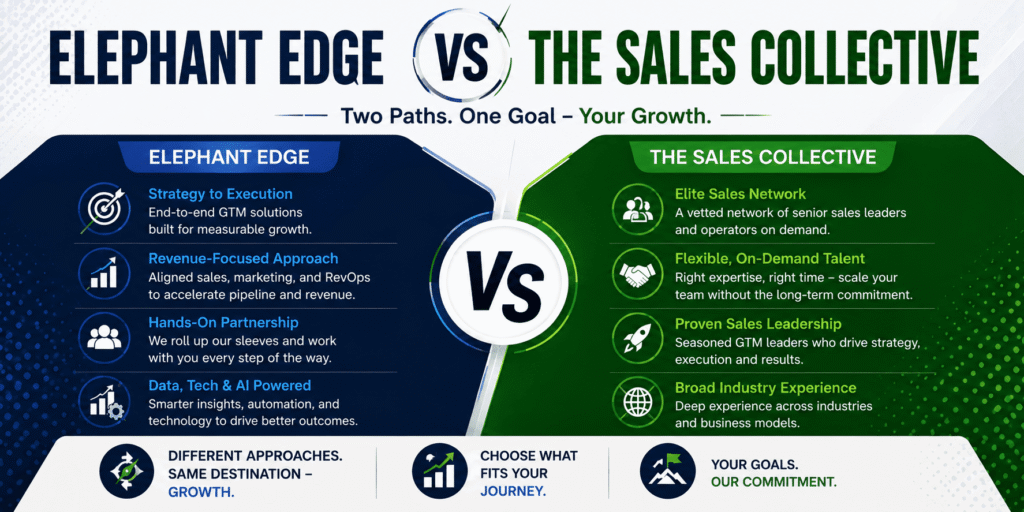
Elephant Edge vs The Sales Collective
Overview: Optimizing Your Sales Team vs Building Your Sales Engine Most companies believe growth problems...
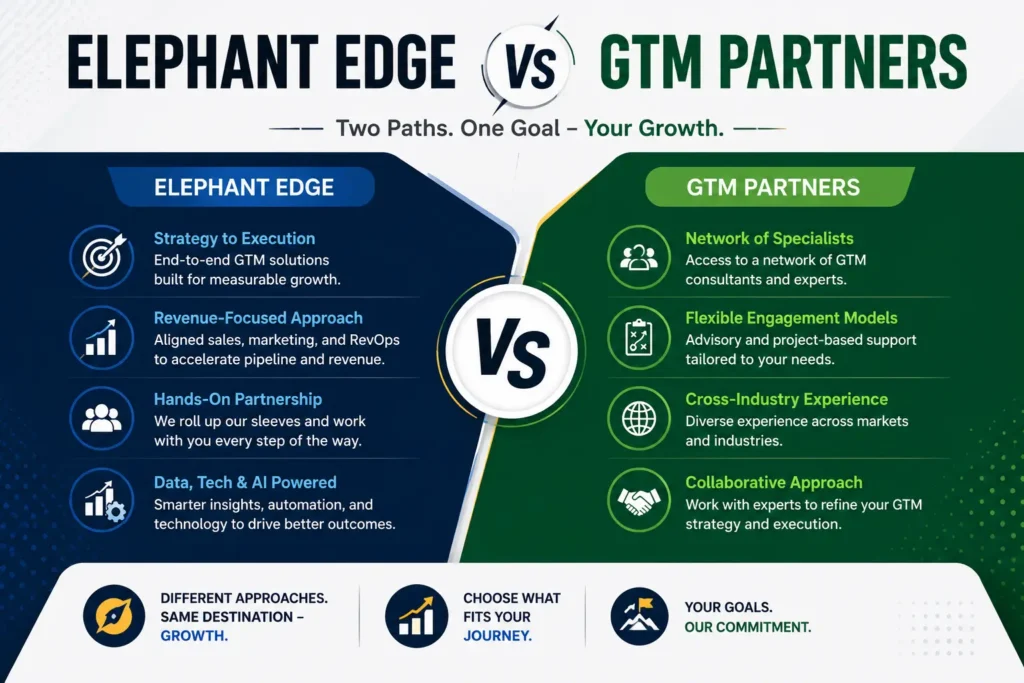
Elephant Edge vs GTM Partners
Overview: GTM Transformation vs Building Your First Revenue Engine Every growing technology company eventually reaches...
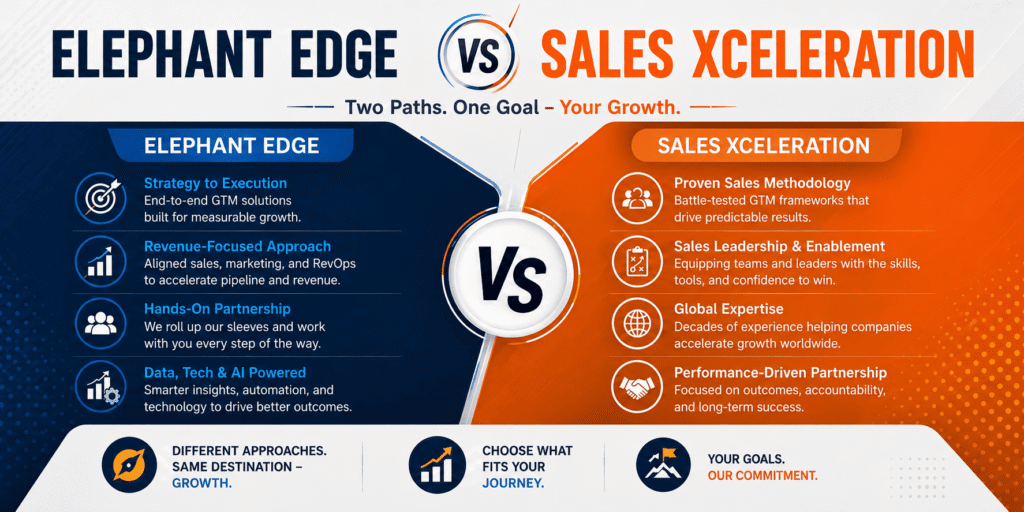
Elephant Edge vs Sales Xceleration
Overview: Managing Your Sales Organization vs Building Your US Revenue Engine Every company reaches a...
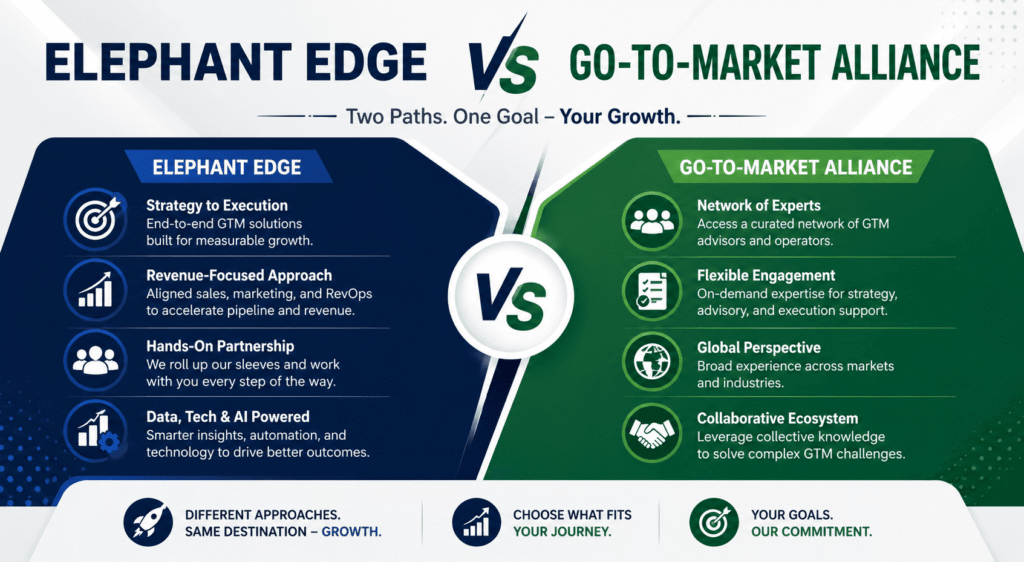
Elephant Edge vs Go-to-Market Alliance
Overview: Learning GTM vs Building Your GTM Engine Every technology company eventually faces the same...