
The Ultimate Founder Led Sales Guide: When to Scale and When to Step Back
Every SaaS or Agentic AI startup begins its sales journey the same way. The founder sells.
In the early days this makes perfect sense. The founder understands the product better than anyone else. They know the story behind the company, the real problem the product solves, and the vision that drives the business forward. When founders talk to early customers, the conversations feel authentic and convincing.
Many of the first deals happen because of this direct engagement. Founders can adjust messaging on the fly, answer technical questions, and build trust quickly.
But as the company begins expanding into larger markets such as the United States, founder led sales eventually becomes a bottleneck. What worked for the first ten customers rarely works for the next hundred. The founder cannot attend every discovery call, handle every objection, and manage every contract negotiation.
For SaaS and Agentic AI companies trying to build a strong presence in the US market, understanding when to scale the sales motion and when to step back from founder driven selling is critical. A well timed founder-led sales transition helps the company build repeatable processes and scalable revenue systems.
This guide explores how founder led sales works, why it becomes a constraint, and how startups can evolve their go to market strategy without losing the insights that made their early success possible.
Why Founder Led Sales Works in the Beginning
Founder led selling is a powerful advantage in the early stages of a company.
Founders speak with authenticity and deep knowledge about the problem they are solving. Buyers often appreciate this transparency. Early conversations feel less like traditional sales calls and more like collaborative discussions about solving a real business problem.
In SaaS and AI startups, founders also tend to have strong technical credibility. This matters especially when selling new technologies such as automation platforms or Agentic AI tools. Buyers want to understand how the technology works and whether it can integrate with existing systems.
These early conversations provide valuable insights into US buyer psychology. Founders learn how different buyers frame their challenges, what objections they raise, and how they evaluate new technology vendors.
This learning stage helps refine messaging and improve ICP clarity. It also reveals which industries respond best to the solution.
Because of this direct feedback loop, founder led sales often leads to strong product market alignment.
The Hidden Risks of Staying Too Long in Founder Led Sales
While founder involvement is valuable early on, staying in this stage too long creates several risks.
The first challenge is scalability. A founder can only manage a limited number of conversations each week. As inbound interest grows or outbound campaigns begin generating meetings, the founder becomes overwhelmed.
The second challenge is inconsistency. Without documented sales processes, each conversation depends on the founder’s personal style. When new sales hires join the team, they struggle to replicate the founder’s success.
This leads to one of the most common US founder-led sales pitfalls. Founders assume that hiring salespeople will automatically increase revenue. In reality, new hires need clear playbooks, messaging frameworks, and training to succeed.
The third challenge appears during US market expansion. Selling into the United States often involves longer US SaaS sales cycles and more structured buying processes. Deals may involve security reviews, procurement approvals, and financial stakeholders.
Without structured sales enablement for SaaS teams, these complexities slow down the pipeline.
Recognizing these risks early allows founders to prepare for the next stage of growth.
The Signals That It Is Time to Scale Sales
Several signals indicate that a company is ready to move beyond founder led selling.
One signal is repeatable demand. If multiple customers in similar industries respond positively to the product, the company likely has the foundation for a scalable go to market motion.
Another signal is clear ICP clarity. When the team understands which types of companies convert most frequently, outbound campaigns can be designed around those segments.
A third signal is predictable messaging. When founders notice that the same problem statement resonates with buyers across multiple conversations, that message can be translated into structured SDR outbound scripts.
Finally, companies should evaluate their internal bandwidth. If the founder is spending more time managing deals than improving the product or strategy, the business may benefit from building a dedicated sales team.
At this stage many startups seek support from US GTM consulting partners or SaaS GTM consultants who specialize in building repeatable sales systems.
Building the First Sales Playbook
The most important step in the founder-led sales transition is documenting the sales process.
Founders often carry valuable knowledge in their heads. They know which questions reveal the buyer’s real challenges. They know how to address common US sales objections. They know how to frame pricing conversations in a way that aligns with buyer expectations.
To scale sales successfully, this knowledge must be translated into structured playbooks.
Sales playbooks for SaaS typically include several components.
They outline the ideal customer profile and segmentation strategy. They describe how to qualify prospects during discovery calls. They provide messaging frameworks that explain the product’s value clearly.
Playbooks also include sales discovery frameworks that help sales representatives uncover operational pain points. They provide guidance on how to navigate proof of value engagements versus open ended proof of concept discussions.
Documenting these processes allows new hires to replicate successful conversations rather than improvising each interaction.
Building the Outbound Engine
Once the playbook is established, the next step is building a structured outbound motion.
Outbound becomes the engine that generates new opportunities. SDR teams use targeted campaigns to reach companies that match the ideal customer profile.
Strong B2B SaaS outbound frameworks rely on segmentation and buyer research. Each campaign focuses on a specific industry or operational challenge. Messaging reflects the real problems faced by that segment.
Outbound agencies for US SaaS often help startups refine this approach by testing different messaging strategies and analyzing response rates.
When outbound is aligned with ICP clarity, pipeline growth becomes more predictable. This allows founders to focus on strategic initiatives rather than chasing individual deals.
Preparing for US Enterprise Selling
As startups gain traction in the US market, they eventually encounter larger enterprise buyers.
Enterprise organizations often have more structured purchasing processes. Decisions involve multiple stakeholders, including finance teams, security teams, and procurement departments.
Understanding US enterprise procurement dynamics becomes important for navigating these conversations.
Sales teams must also prepare to address AI governance for enterprise buyers. Many organizations now evaluate AI solutions through formal governance frameworks. Questions about data usage, compliance, and AI model safety concerns may arise during evaluation.
A strong AI GTM strategy anticipates these questions and provides clear documentation that supports the buyer’s internal review process.
Companies entering this stage often work with an AI commercialization consultant or sales consulting for AI startups to refine their enterprise sales approach.
When to Bring in Sales Leadership
As the sales team grows, leadership becomes increasingly important.
A Fractional VP Sales or Fractional VP Sales for SaaS can help guide the organization through the next stage of GTM development. These leaders bring experience in building scalable sales organizations and designing structured revenue processes.
They help align outbound strategy, pricing strategy for US buyers, and sales enablement initiatives. They also ensure that sales representatives follow consistent discovery and qualification frameworks.
For many startups entering the US market, working with a US sales execution firm or US sales readiness consulting partner accelerates this transition.
These advisors help evaluate the current GTM maturity and identify the processes needed to support sustainable growth.
How Founders Can Step Back Without Losing Insight
Stepping back from direct selling does not mean losing connection with the market.
Founders should remain involved in strategic conversations with key customers and high value prospects. These interactions provide valuable insights into evolving buyer expectations and emerging industry trends.
However, day to day pipeline generation and deal management should gradually shift to the sales team.
This balance allows founders to focus on product innovation, strategic partnerships, and long term growth initiatives.
It also ensures that the sales organization can operate independently without constant founder involvement.
Final Thoughts
Founder led sales is an essential stage in the growth of every SaaS and Agentic AI startup. It provides direct insight into customer needs and helps shape the early go to market strategy.
But long term success requires moving beyond founder driven selling. As the company grows, structured sales processes, outbound systems, and scalable playbooks become essential.
By recognizing the right time to scale and building strong GTM foundations, startups can create revenue engines that operate consistently and efficiently.
For companies entering the US market, this transition is especially important. Structured sales systems help navigate complex buying environments, address evolving AI evaluation criteria, and build credibility with enterprise buyers.
When founders learn to step back at the right time, they give their companies the space to grow faster, scale sustainably, and compete effectively in one of the most competitive markets in the world.
Win Your First $1M in US Market
Effective Sales Execution: The Enormous AI Advantage for CEOs of Small Sales Teams
It’s 9 PM and you’re still in the CRM. Following up on a proposal your...
From Chaos to Clarity: 3 Things AI Will Do for SMB Revenue Teams
There’s an awkward stage in the life of an SMB. You’re doing $3 million, maybe...
Elephant Edge vs The Sales Collective
Overview: Optimizing Your Sales Team vs Building Your Sales Engine Most companies believe growth problems...
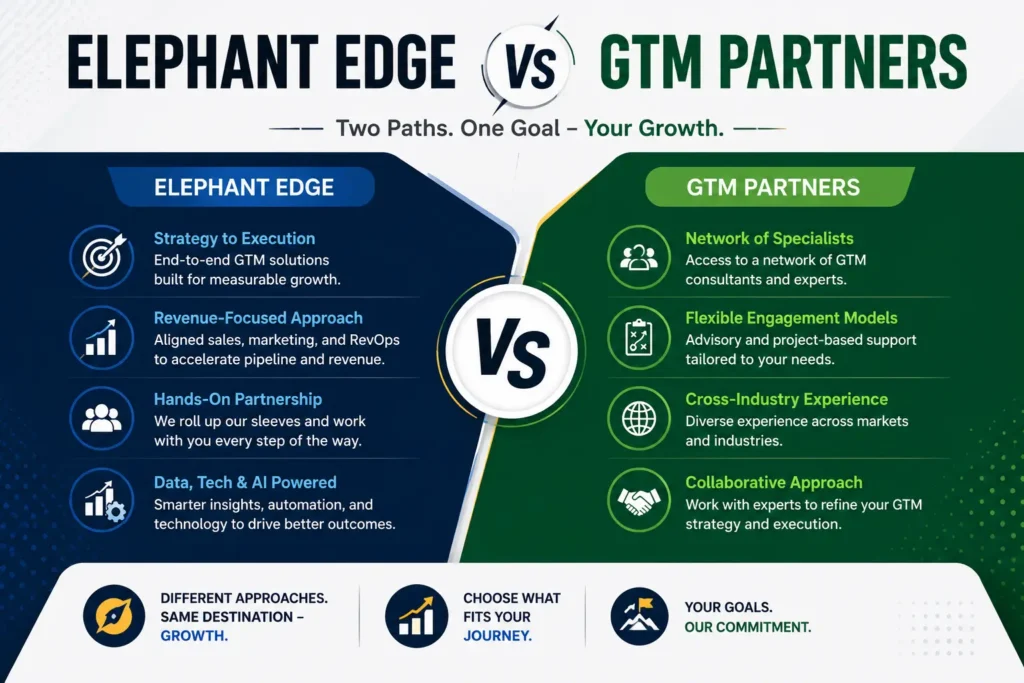
Elephant Edge vs GTM Partners
Overview: GTM Transformation vs Building Your First Revenue Engine Every growing technology company eventually reaches...
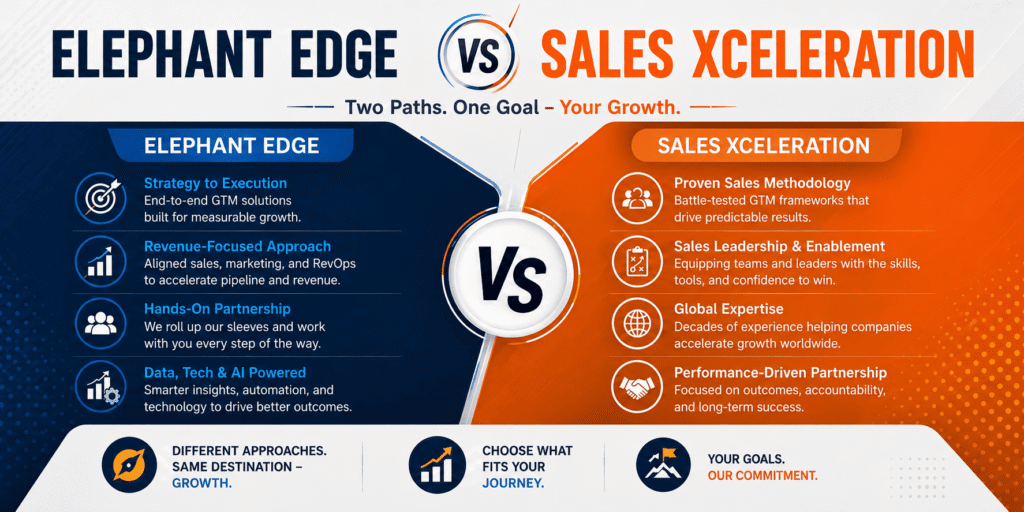
Elephant Edge vs Sales Xceleration
Overview: Managing Your Sales Organization vs Building Your US Revenue Engine Every company reaches a...
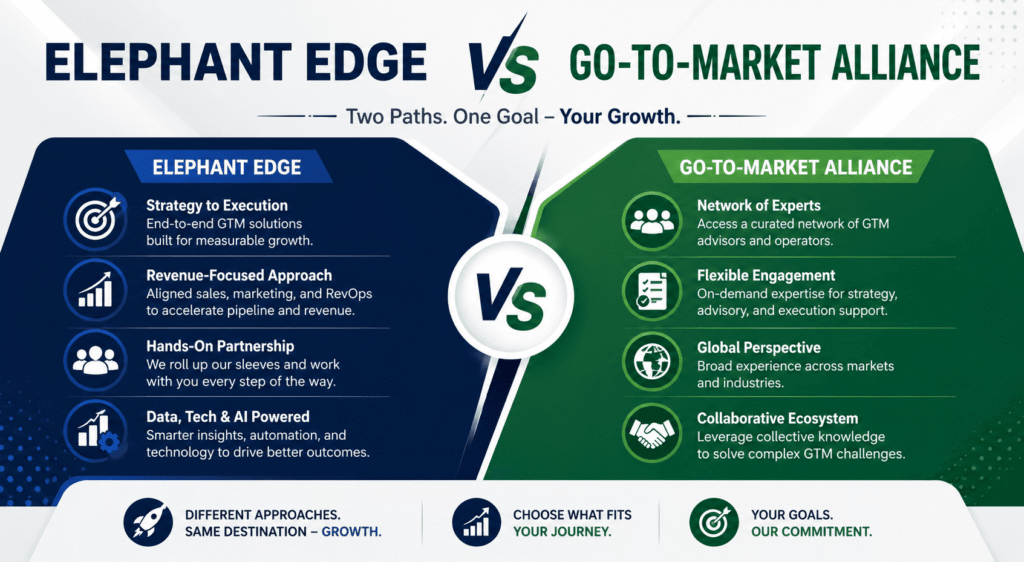
Elephant Edge vs Go-to-Market Alliance
Overview: Learning GTM vs Building Your GTM Engine Every technology company eventually faces the same...