
March 2026 · 14 min read
How to Implement Sales Methodologies Successfully in an Agentic AI or SaaS Startup
Before We Dive In
→ Sales methodology implementation fails when enforcement is weak. Most teams announce a framework and never operationalize it, and that gap is where revenue predictability breaks down.
→ Start with pipeline diagnostics, not methodology selection. Analyze conversion rates, sales cycle length, and deal slippage before choosing a framework.
→ In an agentic AI startup, the stakes are higher. You are selling a category buyers are still defining, which means your sales methodology must create structure where none exists in the buyer’s mind.
→ Match the methodology to your real performance gaps, not to what is trendy. If qualification is weak, fix discovery. If forecast accuracy suffers, tighten stage exit criteria.
→ Adoption depends on reinforcement. Managers must coach against defined criteria, CRM stages must reflect the framework, and pipeline reviews must align with it consistently.
→ A VP of Sales for a VP Sales Startup is ultimately the person responsible for making this stick. Without experienced sales leadership driving the process, methodology becomes documentation, not revenue.
High-performing sales teams are 3.5x more likely to follow a defined sales process than underperforming teams. That gap explains everything. The framework itself rarely determines success. Consistent adoption and reinforcement do.
For a SaaS startup or an agentic AI startup targeting the US market, this matters more than ever. You are not selling a commodity. You are selling a capability that most buyers have never bought before, one that requires them to reimagine how they work. Without a structured sales methodology underpinning your go-to-market motion, every deal depends on individual heroics rather than repeatable execution.
This guide covers what sales methodologies actually are, the 13 most important frameworks to understand, how to implement one without derailing your team’s performance, and why your VP of Sales plays a defining role in making it all stick.
What a Sales Methodology Actually Means
A sales methodology defines how your team approaches selling. It is not your sales process. It is the thinking framework behind it.
While a sales process outlines the stages of a deal, prospecting, discovery, proposal, and close, a sales methodology shapes how reps engage buyers within each of those stages. It creates consistency in how your team qualifies opportunities, handles objections, communicates value, and moves deals forward.
For an agentic AI startup, this distinction is critical. Your product may be technically sophisticated, but your sales methodology determines whether buyers understand why they need it, feel confident in their decision, and ultimately sign.
The right methodology for your SaaS startup or agentic AI company should align with four things: your target customer profile, your average deal size and sales cycle length, your core KPIs, and how your buyers in the US market make purchasing decisions.
Sales Process vs. Sales Methodology, the difference in plain terms:
A sales process answers “what happens and in what order?” It is owned by sales operations and measured by stage progression and pipeline velocity.
A sales methodology answers “how do conversations happen and how is value positioned?” It is owned by sales leadership and measured by win rates, deal quality, and qualification strength.
A process without a methodology creates activity without discipline. Reps move deals forward but qualification is weak and forecasts become unreliable. A methodology without a process creates smart conversations but no structure. Deals lack visibility and scaling becomes difficult. High-performing teams align both. The process defines stage entry and exit criteria. The methodology defines what must be validated before advancing.
Why Standardizing Your Sales Approach Pays Off
Adopting a structured sales methodology is not about adding theory to your team’s workload. It is about creating predictable execution that compounds over time. For a VP Sales Startup, this is the difference between a team of individual contributors and a revenue engine.
1. Faster Onboarding and Stronger Early Performance
A defined methodology gives new hires clarity from day one. Instead of guessing how to qualify, position, or close, they follow an established framework. This reduces ramp time and allows new reps to contribute to pipeline faster. For a fast-growing agentic AI startup making multiple sales hires simultaneously, this acceleration is significant.
2. Consistency Across the Sales Team
Without a common methodology, every rep develops their own style, leading to uneven messaging, inconsistent qualification standards, and unreliable forecasts. A unified framework creates a shared discovery structure, clear stage definitions, consistent qualification criteria, and a predictable customer experience. In the US market, where enterprise buyers often speak to multiple vendors simultaneously, consistency in how your team shows up is a competitive advantage.
3. Scalable Execution as You Grow
Growth exposes weak systems. When hiring accelerates, informal sales habits break down. A standardized sales methodology makes it easier to replicate top-performer behavior, train new teams efficiently, and expand into new US market segments without resetting performance from scratch. Scalability depends on repeatable execution, not individual heroics.
4. Stronger Lead Management and Higher Win Rates
A clear methodology guides how reps move opportunities through each stage. It defines what must be validated before progressing a deal, reducing stalled pipeline and false optimism. When reps understand how to manage objections, confirm buying intent, and secure next steps, conversion rates improve. For an agentic AI startup where every deal requires significant buyer education, this discipline is not optional. It is survival.
13 Sales Methodologies to Understand Before You Implement
Not every framework fits every team. Some are built for enterprise qualification. Others work better for early-stage pipeline building. Here is a clear breakdown of the most widely used methodologies and where each fits best, with an eye toward what works for SaaS startups and agentic AI companies selling into the US market.
1. SPIN Selling
SPIN Selling is built around structured discovery. It assumes that strong sales outcomes begin with better questions, not better pitches. SPIN stands for Situation, understanding the prospect’s current environment, Problem, identifying specific challenges, Implication, expanding on the consequences of those problems, and Need-Payoff, positioning your solution as a clear resolution.
For an agentic AI startup, SPIN is particularly powerful. Many buyers do not yet recognize the full operational cost of the problems your product solves. Implication questioning creates the urgency needed to move deals forward.
Best fit: Mid-market or enterprise teams selling complex products with longer cycles. Highly applicable to agentic AI startup sales.
Limitation: Requires strong listening skills and can feel mechanical if reps over-script it.
2. N.E.A.T. Selling
N.E.A.T. evolved from BANT-style qualification by prioritizing impact and authority over surface-level budget questions. It covers Need, what core business issue must be solved, Economic Impact, the measurable financial consequence, Access to Authority, whether you are engaging real decision-makers, and Timeline, when this decision must happen.
Rather than asking about budget upfront, you quantify the cost of the problem. If operational inefficiencies cost a prospect $300K annually, your $50K solution becomes economically justified before price is ever discussed.
Best fit: Revenue teams struggling with forecast accuracy or late-stage deal slippage, a common pain point for VP Sales Startup environments.
Limitation: Not built for early prospecting stages. Use once deals have qualified intent.
3. SNAP Selling
SNAP Selling was designed for distracted, overloaded buyers, which describes virtually every US enterprise buyer your agentic AI startup will target. SNAP stands for Simple, make communication easy to understand, iNvaluable, deliver undeniable value immediately, Aligned, connect directly to buyer priorities, and Priority, emphasize urgency and business importance.
Where most methodologies focus on deep qualification, SNAP focuses on attention and initial engagement. It is the methodology most relevant to outbound SDR motions in a SaaS startup context.
Best fit: High-volume outbound teams or early pipeline development.
Limitation: Less structured for later-stage deal management.
4. MEDDIC
MEDDIC is one of the most widely adopted enterprise sales qualification frameworks. It stands for Metrics, quantifiable outcomes the buyer cares about, Economic Buyer, the person with budget authority, Decision Criteria, how the buyer evaluates options, Decision Process, the steps required for approval, Identify Pain, the core business challenge, and Champion, an internal advocate driving your solution forward.
For an agentic AI startup navigating complex enterprise deals in the US market, often involving IT, security, procurement, and business units simultaneously, MEDDIC provides the structural discipline needed to forecast accurately and avoid late-stage surprises.
Best fit: Enterprise SaaS teams or companies scaling complex multi-stakeholder deals.
Limitation: Requires CRM discipline to track properly. Invest in RevOps infrastructure before rolling this out.
5. Challenger Selling
Challenger Selling shifts the dynamic from reactive to insight-driven. Instead of responding to expressed needs, the rep introduces new perspectives that reshape the buyer’s view of their problem. It is built around three behaviors: Teach, provide unique commercial insight the buyer has not considered, Tailor, adapt messaging to specific stakeholders, and Take Control, guide the conversation confidently, especially around value and pricing.
For an agentic AI startup, this methodology is especially relevant. Your buyers are often not looking for what you sell and may not even know it exists yet. Challenger reps create the conversation rather than wait for RFPs.
Best fit: Organizations selling differentiated solutions in competitive markets where insight, not price, drives decisions.
Limitation: Requires deep industry knowledge. Poorly executed, it can feel aggressive.
6. Inbound Selling
Inbound Selling aligns with inbound marketing principles. Prospects engage first through content, search, or digital channels, and the sales conversation continues from that point of prior engagement. Rather than delivering a generic pitch, reps reference specific buyer behavior such as a downloaded white paper, a webinar attended, or a page visited, and tailor conversations accordingly.
For a SaaS startup with an established content engine, this methodology creates warmer pipeline entry points and stronger marketing and sales alignment.
Best fit: Companies with strong inbound marketing pipelines and digital-first acquisition strategies.
Limitation: Dependent on marketing investment. Less effective where outbound dominates.
7. Customer-Centric Selling
Customer-centric selling prioritizes long-term value over short-term transactions. It focuses on understanding the customer’s broader goals, not just the immediate purchase trigger, and positions the sale as the beginning of a relationship rather than the end of a process.
For a SaaS startup or agentic AI company with a recurring revenue model, this methodology aligns naturally with expansion and retention economics. The goal is not to close the deal. It is to earn the right to grow the account.
Best fit: Recurring revenue businesses where long-term value outweighs one-time transaction size.
Limitation: Can lengthen initial sales cycles. Requires tight alignment with customer success.
8. Conceptual Selling
Conceptual Selling focuses on understanding how the buyer conceptualizes their problem and their ideal solution. Instead of pushing product features, the rep aligns with the buyer’s perception of the issue, their vision of success, and their definition of value.
This is particularly valuable in agentic AI startup sales, where buyers often arrive with a vague understanding of the problem, such as “we need to be more efficient,” and the rep must help them see the problem clearly before introducing the solution.
Best fit: Solution-based software sales where customization and alignment drive differentiation.
Limitation: Requires advanced communication skills. Less structured for closing mechanics.
9. Target Account Selling (TAS)
Target Account Selling prioritizes depth over volume. Instead of working broad pipelines, TAS focuses on a defined set of high-value accounts by mapping decision-makers and influencers, coordinating multi-touch engagement, and building executive relationships over time.
For an agentic AI startup with a clear ICP targeting specific US market verticals, TAS provides a framework to go deep rather than wide, generating higher win rates and stronger reference accounts.
Best fit: Enterprise-focused teams running account-based strategies.
Limitation: Slower pipeline velocity. Requires significant research investment per account.
10. The Sandler Selling System
The Sandler Selling System reframes the traditional seller and buyer dynamic. Instead of positioning the rep as the persuader, it frames the conversation as a mutual qualification process. Both parties determine whether there is a genuine fit, and reps are encouraged to disqualify poor-fit prospects rather than force deals forward.
Core elements include establishing upfront contracts, maintaining equal business stature, and discussing budget and decision authority early and transparently.
For a VP Sales Startup leader building a sustainable sales culture, Sandler reduces late-stage deal collapse and builds a pipeline of genuinely qualified opportunities.
Best fit: Teams prioritizing sustainable growth over transactional wins.
Limitation: Can feel counterintuitive for aggressive sales cultures. Requires confidence and discipline.
11. Solution Selling
Solution Selling shifts the conversation from product features to business outcomes. Instead of pitching capabilities, reps diagnose problems and position tailored solutions. The approach emphasizes deep discovery, collaborative conversations, and customized value propositions.
For a SaaS startup where the product is configurable and use cases vary, solution selling allows differentiation based on fit rather than competing on features or price.
Best fit: Complex environments where customization drives advantage.
Limitation: Can lack structure without strong CRM discipline and clear stage criteria.
12. Gap Selling
Gap Selling helps prospects understand the distance between their current state and their desired future state. It centers on diagnosing the current situation, defining the desired outcome, quantifying the cost of inaction, and positioning your product as the bridge.
For an agentic AI startup, where buyers often underestimate the cost of legacy processes, this methodology makes the status quo feel untenable.
Best fit: Outcome-driven teams selling measurable ROI solutions.
Limitation: Requires strong questioning skills and comfort with business discussions.
13. Value Selling
Value Selling emphasizes clearly articulating return on investment. It shifts conversations from price to impact by quantifying outcomes such as time savings, revenue lift, and cost reduction, and tying proposals to executive metrics.
This becomes critical when US enterprise buyers involve finance stakeholders. The conversation must move from cost to return.
Best fit: Enterprise sales and price-sensitive markets.
Limitation: Requires strong financial fluency and accurate ROI data.
How to Roll Out a Sales Methodology Without Disrupting Performance
Selecting a methodology is not the same as implementing it. Most companies fail not because they chose the wrong framework, but because they never operationalized it across processes, tools, and leadership disciplines. Here is how to do it correctly.
Step 1 — Diagnose Performance Gaps First
Before choosing any methodology, analyze your pipeline stage by stage. Look at conversion rates, sales cycle length, win rates, and deal slippage patterns. Then speak with sales managers, reps, RevOps, and leadership. Numbers show where friction exists. Conversations explain why it exists. A methodology should solve specific execution problems, not serve as a trend-driven reset.
Step 2 — Select a Methodology That Matches Your Reality
Once gaps are clear, choose a framework that addresses those weaknesses. Consider business objectives, deal complexity, and how your US market buyers make decisions.
As a guide, if qualification is weak, adopt SPIN, N.E.A.T., or MEDDIC. If deal control is inconsistent, use MEDDIC or TAS. If forecasting is unreliable, enforce stricter exit criteria. If differentiation is difficult, consider Challenger Selling. For an agentic AI startup, a combination of Challenger and MEDDIC is often most effective.
Avoid overhauling everything at once. Preserve what works and improve what does not.
Step 3 — Align With Existing Workflow and Tools
Ensure CRM stages match methodology criteria, exit conditions are defined, managers reinforce during reviews, and metrics align with the process. Execution discipline determines success.
Step 4 — Communicate the Why Clearly
Reps must understand the rationale. Explain what problem it solves and how it improves outcomes for them. Support with training, coaching, and reinforcement.
Step 5 — Reinforce With the Right Sales Infrastructure
Technology enforces discipline. Choose tools that support qualification, tracking, and forecasting. Most importantly, your VP of Sales must reinforce the methodology consistently. Without leadership, adoption fades quickly.
Why Implementation Ultimately Falls on Your VP of Sales
Sales methodologies do not fail because the framework is wrong. They fail when no one reinforces them consistently. Pipeline reviews slip. Coaching becomes uneven. Stage criteria soften. Within months, the methodology exists only in a slide deck, not in execution.

The VP of Sales is the most important variable in successful implementation. Their role is to make the methodology the operating system of the revenue team. This includes coaching against criteria, aligning CRM stages, building training programs, and holding managers accountable.
For a SaaS or agentic AI startup targeting the US market, the VP also determines which methodology fits your buyer profile. Experience in enterprise sales brings pattern recognition that frameworks alone cannot provide.
This is why hiring a VP of Sales early in your growth journey is critical.
Measuring Whether Your Sales Methodology Implementation Is Actually Working
Initial rollout can take 30 to 60 days, but full adoption requires 90 to 180 days of reinforcement and refinement before measurable improvements appear. Track these indicators:
Stage-to-stage conversion rates
Are deals progressing consistently or stalling?
Sales cycle length
Is time to close reducing?
Win rate
Are more deals converting?
Deal slippage rate
Are fewer deals slipping across quarters?
Forecast accuracy
Is forecast reliability improving?
If these remain flat after 90 days, adoption is incomplete. Identify where reinforcement is breaking down and fix it.
Conclusion
Sales methodology implementation is not a one-time initiative. It is an operational shift that reshapes how your revenue team thinks, qualifies, and closes.
For a SaaS or agentic AI startup targeting the US market, the stakes are high. You are building a strategy in a category buyers are still learning. The teams that win are not just those with the best product. They are the ones with disciplined, consistent, and buyer-aligned execution.
A well-implemented sales methodology creates that edge. Your VP of Sales ensures it sticks.
Frequently Asked Questions
What is sales methodology implementation?
Sales methodology implementation is the process of embedding a structured framework into daily execution. It involves aligning stages, coaching, CRM configuration, and metrics so that the methodology is reflected in behavior.
Why do sales methodology rollouts fail?
They fail due to inconsistent reinforcement. Managers stop coaching against criteria, CRM stages are loosely enforced, and teams revert to old habits.
How long does it take to implement a sales methodology successfully?
Initial rollout takes 30 to 60 days. Full adoption requires 90 to 180 days of reinforcement and refinement.
Should agentic AI startups use formal sales methodologies?
Yes. These sales environments are complex, multi-stakeholder, and long-cycle. Without structure, execution becomes inconsistent and unscalable.
Which sales methodology works best for a SaaS startup targeting the US market?
There is no single answer, but a combination of MEDDIC and Challenger Selling often provides a strong foundation. Your VP of Sales should diagnose specific needs.
Do you need a VP of Sales to implement a sales methodology?
Not to select one, but to sustain it. Without consistent leadership reinforcement, methodology adoption degrades within 60 to 90 days.
Elephantedge.ai helps agentic AI and SaaS startups build winning US market sales strategies, from go-to-market design to sales leadership hiring.
Win Your First $1M in US Market

Effective Sales Execution: The Enormous AI Advantage for CEOs of Small Sales Teams
It’s 9 PM and you’re still in the CRM. Following up on a proposal your...

From Chaos to Clarity: 3 Things AI Will Do for SMB Revenue Teams
There’s an awkward stage in the life of an SMB. You’re doing $3 million, maybe...
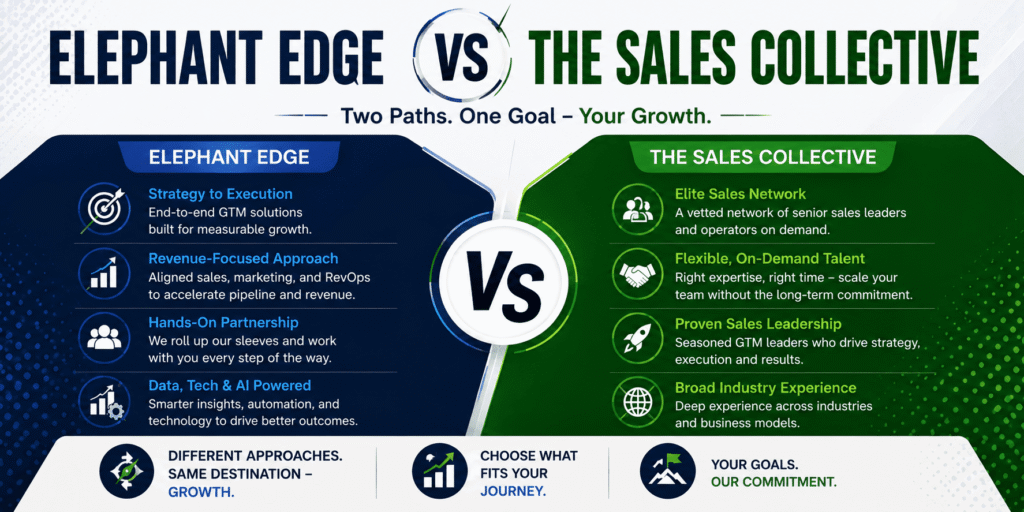
Elephant Edge vs The Sales Collective
Overview: Optimizing Your Sales Team vs Building Your Sales Engine Most companies believe growth problems...
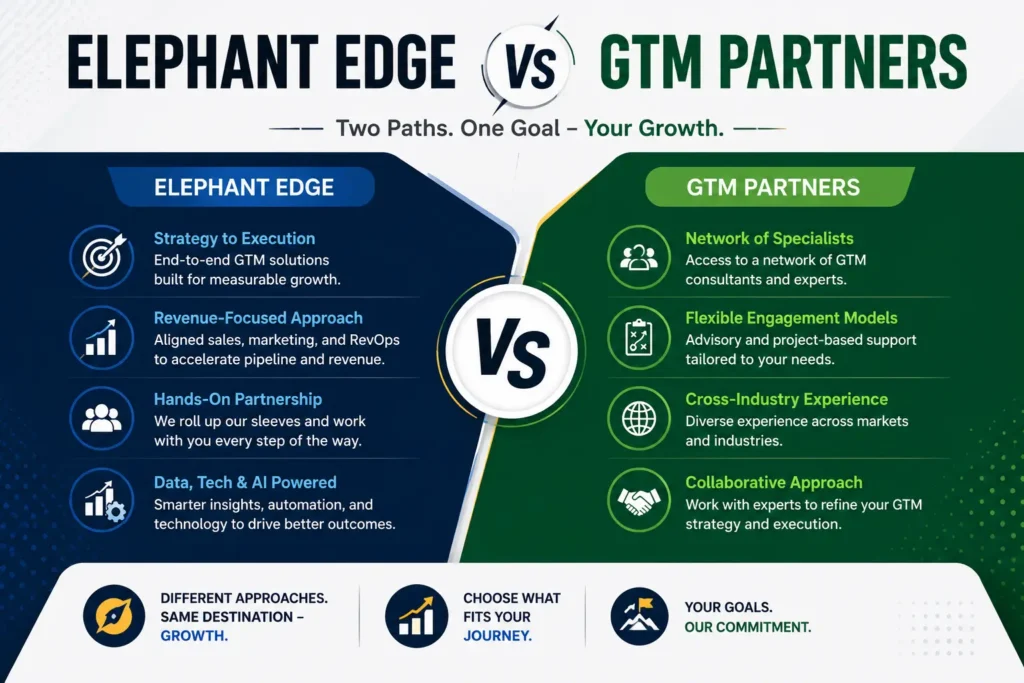
Elephant Edge vs GTM Partners
Overview: GTM Transformation vs Building Your First Revenue Engine Every growing technology company eventually reaches...
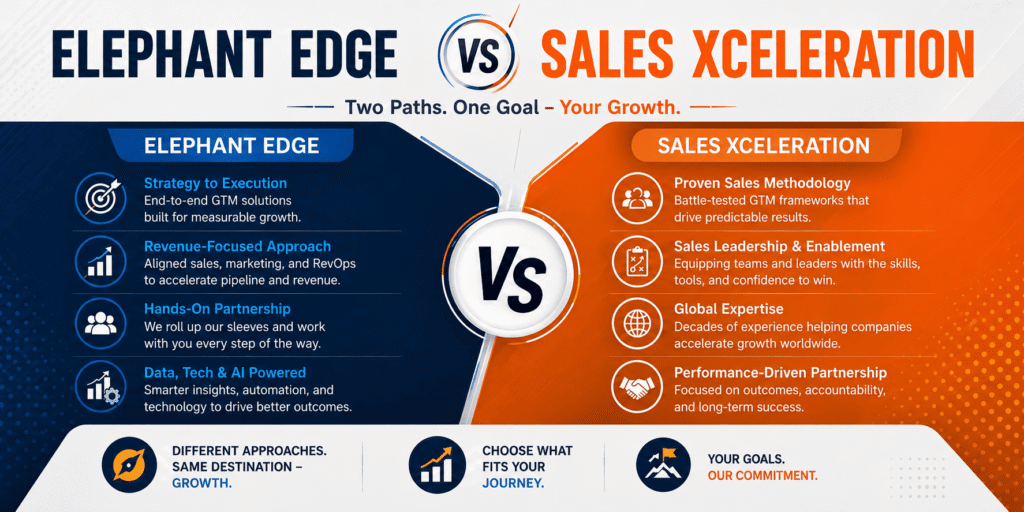
Elephant Edge vs Sales Xceleration
Overview: Managing Your Sales Organization vs Building Your US Revenue Engine Every company reaches a...
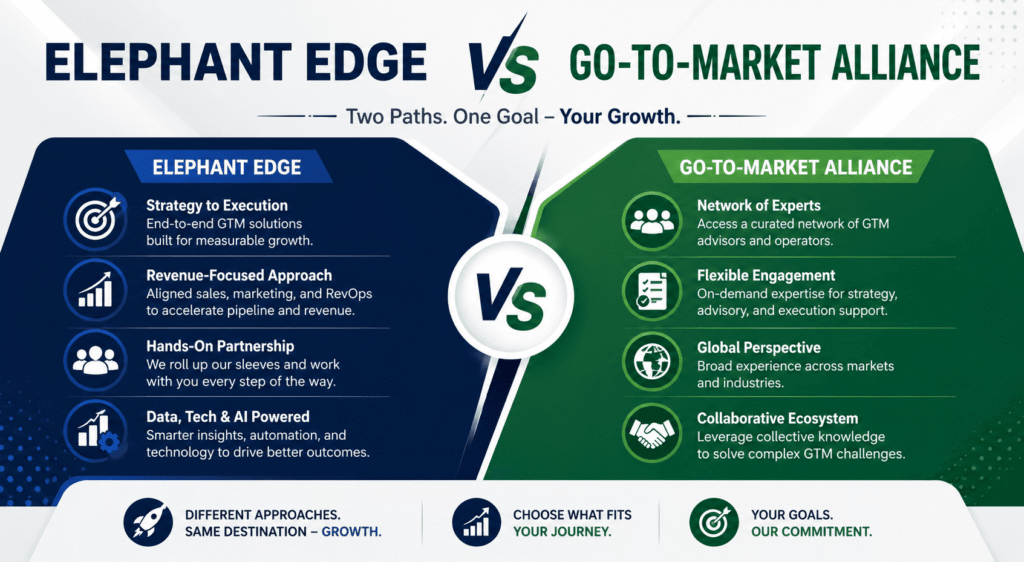
Elephant Edge vs Go-to-Market Alliance
Overview: Learning GTM vs Building Your GTM Engine Every technology company eventually faces the same...