
The Art of Crafting Offers That Convert: A GTM Leader’s Playbook
Most GTM leaders think they have a sales problem. Reps aren’t hitting quota. Pipeline is thin. Conversion rates are stuck. So they hire more reps, run more training sessions, and push harder on activity metrics.
But here’s what’s actually happening in most cases: the offer is broken.
Not the product. The offer. The way you’ve packaged, positioned, and communicated what you do and why someone should care right now. A weak offer makes even the best salespeople look average. A strong offer makes an average team look great.
This guide is about building offers that actually convert. That means getting your positioning sharp, your messaging honest, your ICP insights deeper than a persona doc, and your sales execution tight enough that deals don’t die in the follow-up stage.
Start Here: What an Offer Actually Is
People confuse offers with products. They’re not the same thing.
Your product is what you built. Your offer is how you make someone feel about buying it right now.
A strong offer answers four questions in the buyer’s mind before they even ask them. What exactly am I getting? Why does this matter to my specific situation? Why should I trust that this works? And why should I move on this now instead of waiting three months?
Most GTM teams nail the first question and fumble the rest. They can describe the product clearly but they can’t connect it to the buyer’s specific situation, they don’t have proof that lands with this particular ICP, and they have no real reason for urgency beyond “our quarter ends Friday.”
That’s not an offer. That’s a feature list with a price tag.
Positioning Is Not a Tagline
Here is where most GTM leaders start going wrong. They treat positioning as a marketing exercise. Something that happens in a workshop, gets turned into a one-liner on the website, and then gets ignored in every actual sales conversation.
Real positioning is a strategic decision about who you are built for and what you are not. It only works if it shows up consistently from the first cold email to the renewal conversation.
Strong positioning answers a specific question: compared to every other option your buyer has, including doing nothing, why are you the most logical choice for this exact type of company at this exact stage of their growth?
That answer has to be specific enough to exclude people. If your positioning works for every company with a sales team, it doesn’t really work for anyone. The narrower your positioning, the more it resonates with the people it’s actually meant for.
A useful exercise: write down the last five deals you lost. Not to a competitor. To no decision. What did those companies have in common? Now write down your five fastest closes. What did those companies have in common?
The gap between those two lists is where your real positioning lives. The fast closes tell you exactly who you are built for. The no decisions tell you who you should stop chasing.
Messaging That Sounds Like a Human Wrote It
Bad messaging is everywhere in B2B. You can smell it immediately. It sounds like a press release. It talks about platforms and solutions and seamless integrations. It uses words like robust and next-generation. It describes what the product does without ever touching what the buyer actually cares about.
Good messaging does one thing above everything else. It makes the buyer feel understood before it makes them feel impressed.
That means leading with the problem, not the product. Not “we help companies streamline their revenue operations” but “most RevOps teams are spending 40 percent of their week pulling reports that their CRO doesn’t end up using anyway.” One of those makes the buyer lean in. The other makes them nod politely and go back to their inbox.
The best messaging comes directly from your customers’ own language. Not paraphrased. Not cleaned up. The actual words they use when they describe the problem to someone who’s never heard of your product.
Go pull the transcripts from your last 20 discovery calls. Look for the sentences where the buyer’s tone shifts. Where they stop being polite and start being frustrated. Those sentences are your headlines. Those words are your copy. You didn’t invent them. You’re just reflecting them back.
ICP Insights That Go Beyond Demographics
Every company has an ICP document. Almost none of them are actually useful in a sales conversation.
The typical ICP doc says something like: B2B SaaS companies, 50 to 500 employees, Series A to C, VP of Sales or CRO is the buyer. That is a targeting filter. It is not an insight.
An actual ICP insight sounds like this: our best customers are companies that just missed their revenue target two quarters in a row and have a new CRO who joined in the last six months. They are under pressure to show a methodology shift quickly. They don’t have time for a six-month implementation. They need something that shows results in the first 30 days or it gets cut in the next board meeting.
Do you see the difference? The second version tells you what’s happening in that company right now. It tells you the emotional state of the buyer. It tells you what they need the outcome to look like and how fast. And it tells you exactly how to frame your offer when you get them on the phone.
That level of ICP insight doesn’t come from market research. It comes from talking to your best customers and asking them one question: what was happening in your business in the three months before you decided to buy something like us?
The answer to that question is your real ICP. Not the firmographics. The trigger event.
The Offer Architecture That Actually Converts
Once your positioning is sharp and your messaging sounds like a human wrote it, you need to build the offer itself. Not the pricing page. The actual package of value that you present to a buyer when you’re asking them to make a decision.
A converting offer has four components working together.
The core outcome. Not features. Not capabilities. The specific, measurable thing the buyer will have after working with you that they don’t have today. The more specific the better. “Reduce time to first revenue for new reps by 30 percent in 90 days” converts better than “accelerate sales onboarding.”
The proof mechanism. Why should they believe the outcome is real? Case studies help but they’re not enough on their own. The strongest proof is specificity. A case study from a company that looks exactly like theirs, with a buyer who had the same title and the same problem, is ten times more convincing than a general success story. Build a proof library organized by ICP, not by company name.
The risk reversal. What happens if it doesn’t work? Most B2B companies say nothing about this and hope the buyer doesn’t ask. The best ones address it directly. That might be a pilot period, a performance guarantee, a milestone-based payment structure, or simply a clear offboarding process. Whatever removes the feeling of being trapped makes the yes easier.
The urgency mechanism. This is the hardest one to get right because most urgency in B2B sales is fake and buyers know it. Real urgency is tied to the buyer’s situation, not your sales calendar. Their Q3 planning cycle. A compliance deadline. A board review in six weeks. When you understand the buyer’s actual timeline pressure, you can connect your offer to it honestly. That creates urgency they feel, not urgency you manufacture.
Sales Execution: Where Offers Go to Die
You can have perfect positioning, sharp messaging, deep ICP insight, and a well-built offer and still lose deals in execution. Here are the places it most commonly falls apart.
The demo that shows everything. Most demos are product tours. Buyer asks a question, rep shares their screen, and for the next 45 minutes every feature gets equal airtime. By the end, the buyer is tired and the rep is confused about why there’s no clear next step. A converting demo shows three things: the exact problem the buyer described in discovery, the moment it gets solved in the product, and what life looks like after. Everything else is noise.
The proposal that requires a decoder ring. If your buyer has to work to understand what they’re getting, you’ve already lost momentum. A good proposal has one page that says here is what you told us, here is what we’re recommending and why, here is what it costs, and here is what happens next. That’s it. The appendix can have details. The first page needs to be scannable in 90 seconds.
The follow-up that has no reason to exist. Most follow-up emails say some version of “just checking in to see if you had any thoughts.” That email has no value for the buyer. It only exists to relieve the rep’s anxiety. A follow-up that moves a deal forward adds something: a relevant case study, an answer to an open question, a resource connected to something the buyer mentioned. Every touchpoint needs to give the buyer a reason to open it.
The stall that becomes a ghost. Deals don’t die in a day. They die slowly through a series of unanswered emails and rescheduled calls. The moment a deal goes quiet, the rep needs to change something. Not send the same email again with a different subject line. Change the channel, change the contact, change the angle, or change the offer. Doing the same thing and waiting for a different response is not a sales strategy.
The GTM Leader’s Real Job in All of This
If you’re leading GTM at a growing company, your job is not to close deals. Your job is to build the conditions in which deals close predictably.
That means owning the positioning conversation even when it’s uncomfortable. It means pulling bad-fit prospects out of the pipeline even when it hurts the numbers short term. It means reviewing lost deals not to assign blame but to find the pattern.
And it means treating your offer as a living thing that needs to be updated as your market shifts, your competition moves, and your customer base evolves. The offer that got you to $2M ARR is probably not the offer that gets you to $10M. The best GTM leaders know this and stay curious about it instead of defensive.
The companies that win in competitive markets usually don’t have the best product. They have the best offer. They’ve done the hard work of understanding who they’re for, what those people actually need to hear, and how to remove every obstacle between interest and a signed contract.
That work is never done. But it’s the most valuable work a GTM team can do.
Start with your last five lost deals. Not the competitive losses. The no decisions. Figure out what they had in common. That’s where your offer needs fixing. Everything else flows from there.
Elephantedge.ai helps agentic AI and SaaS startups build winning US market sales strategies, from go-to-market design to sales leadership hiring.
Win Your First $1M in US Market
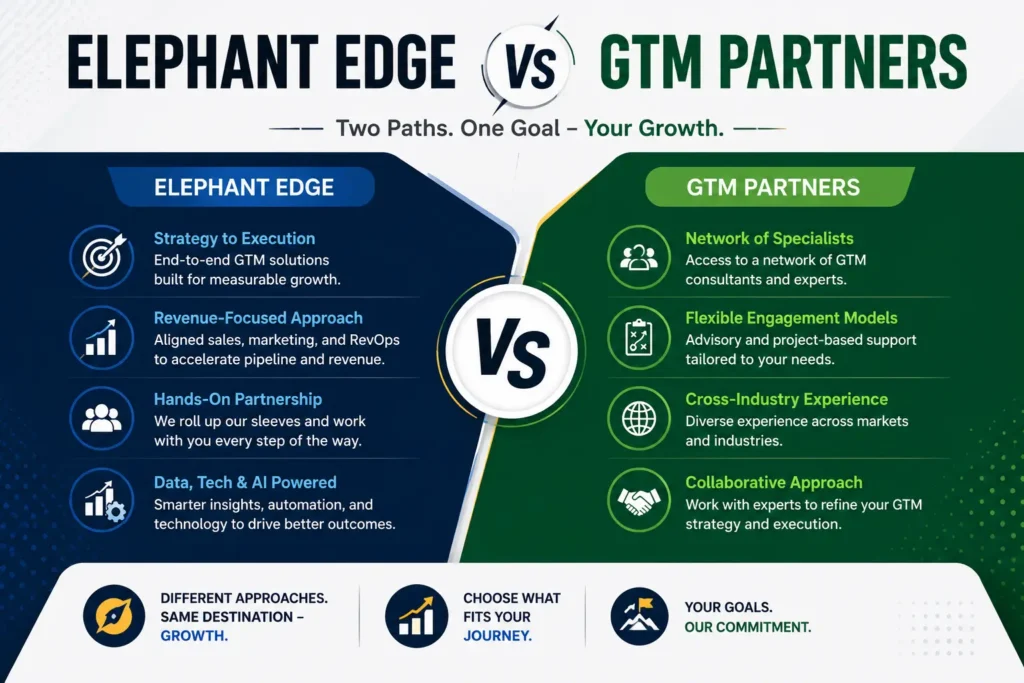
Elephant Edge vs GTM Partners
Overview: GTM Transformation vs Building Your First Revenue Engine Every growing technology company eventually reaches...
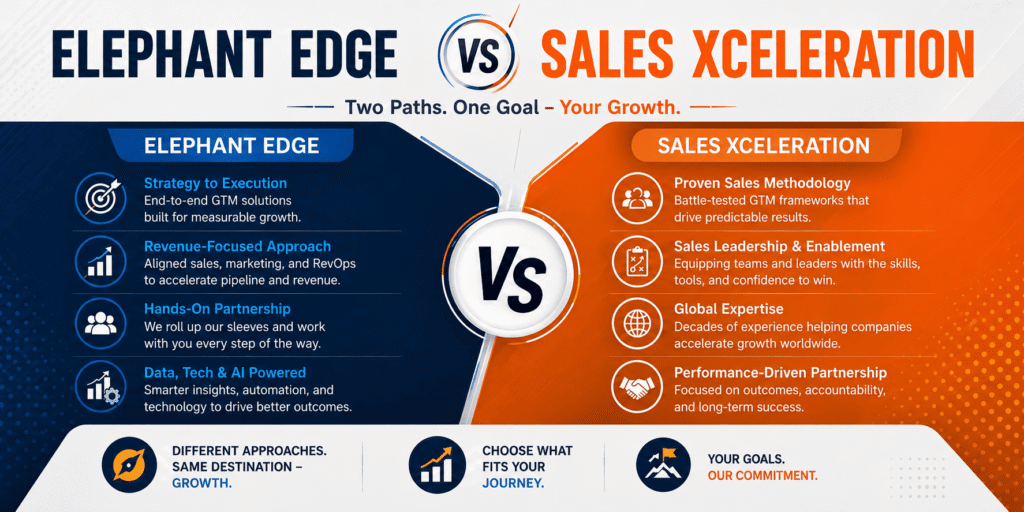
Elephant Edge vs Sales Xceleration
Overview: Managing Your Sales Organization vs Building Your US Revenue Engine Every company reaches a...
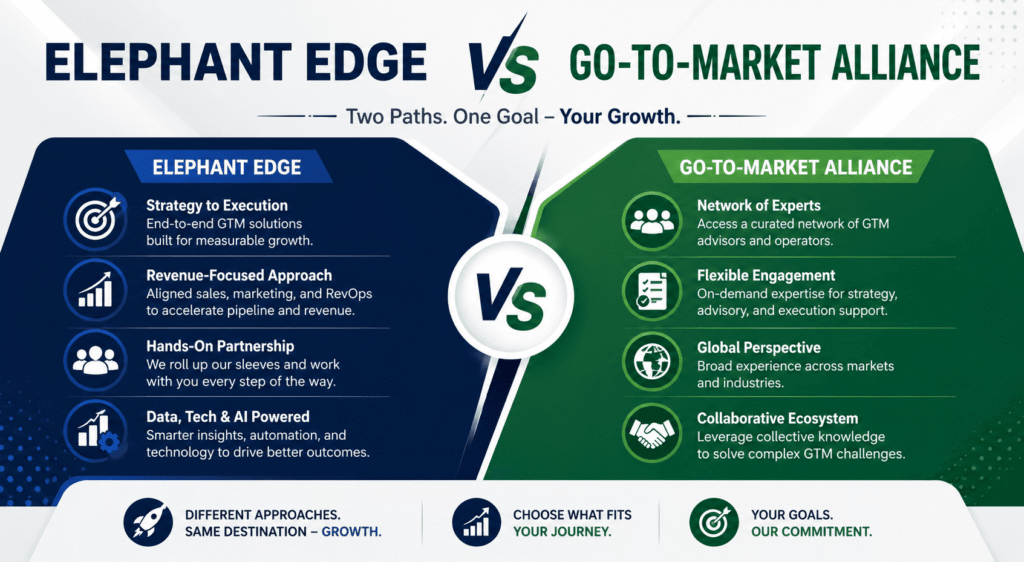
Elephant Edge vs Go-to-Market Alliance
Overview: Learning GTM vs Building Your GTM Engine Every technology company eventually faces the same...
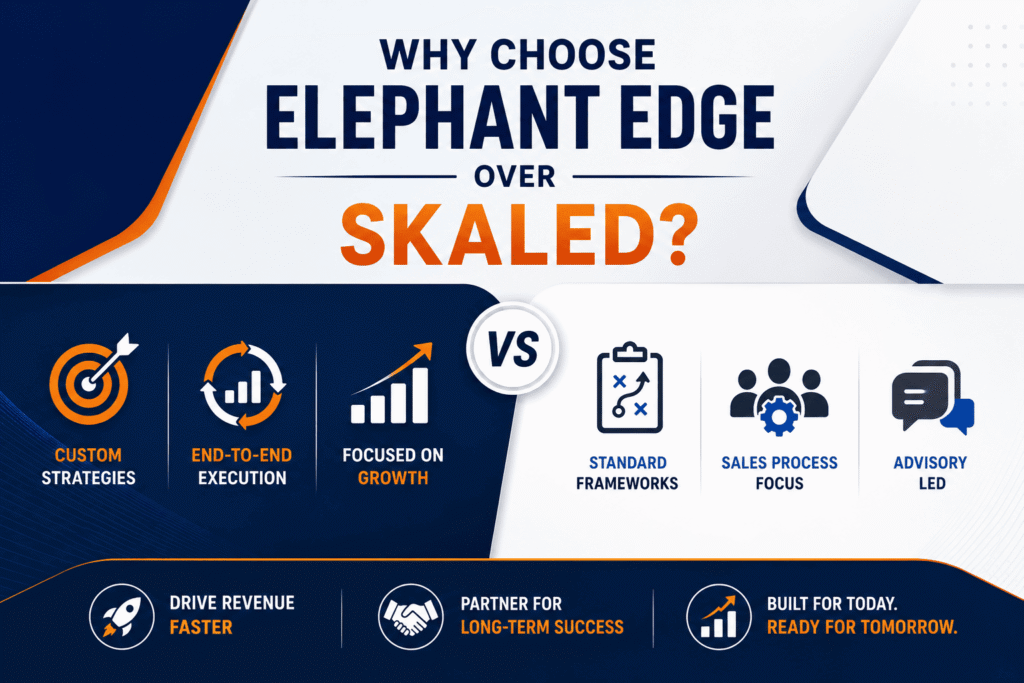
Why Choose Elephant Edge Over Skaled?
Overview Both Elephant Edge and Skaled are GTM consulting firms, but they are built for...
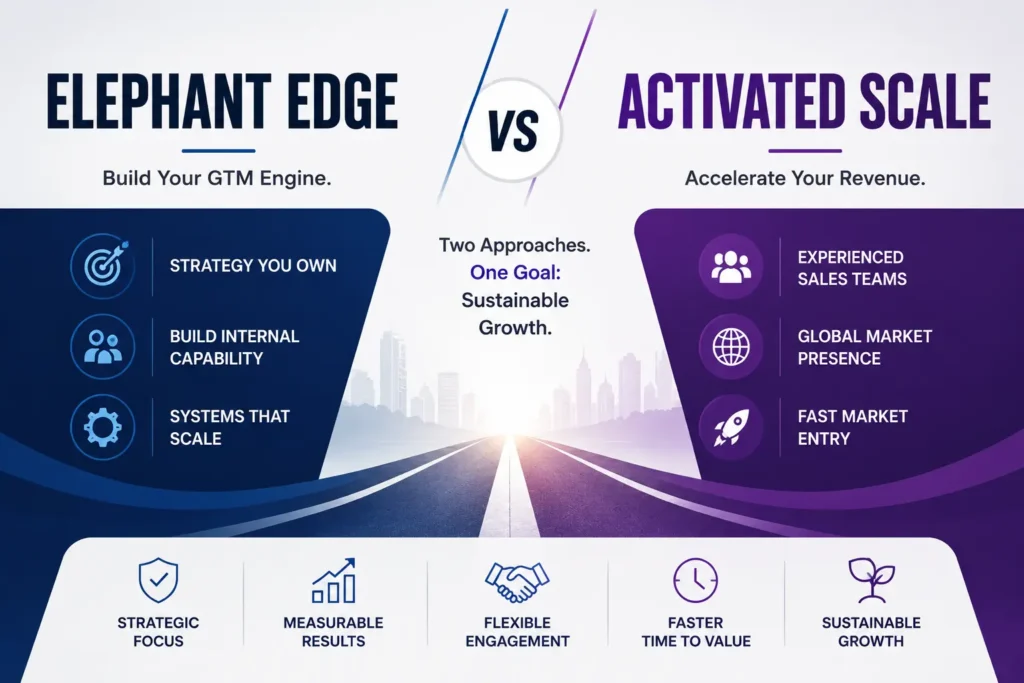
Elephant Edge vs Activated Scale
Overview: Two Very Different Models Elephant Edge and Activated Scale are both designed to help...
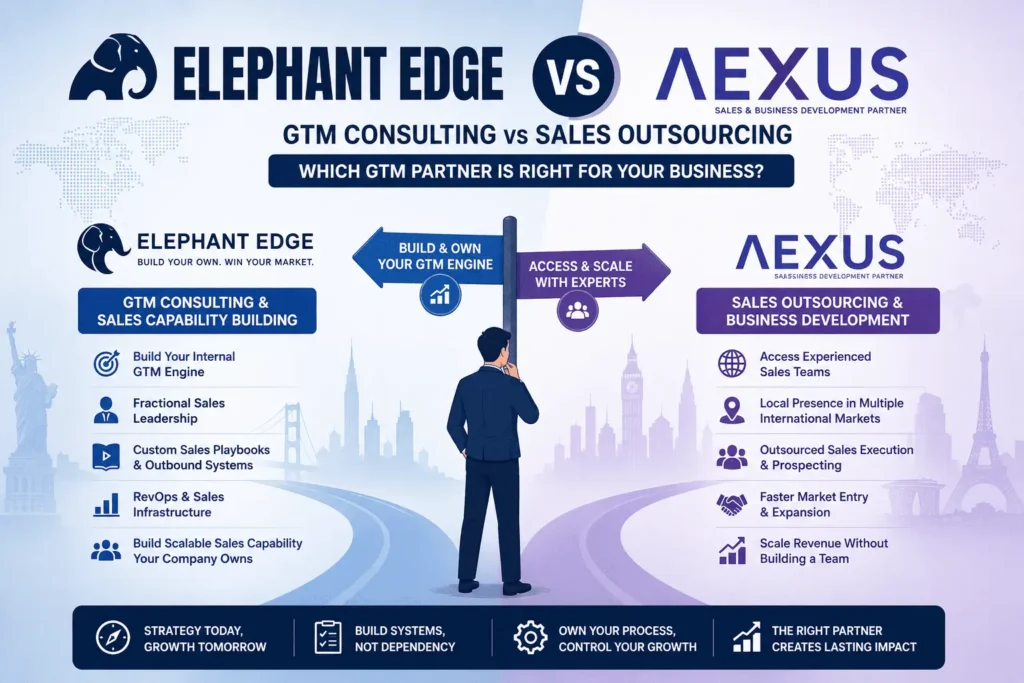
Elephant Edge vs Aexus
Overview: Two Different Ways to Enter a New Market Building revenue in a new market...