
How to Find Companies That Actually Need Agentic AI
Every founder building an Agentic AI product eventually reaches the same question: “Which companies should we sell to?”.
The answer usually starts with an Ideal Customer Profile: Healthcare, Manufacturing, Financial Services, Mid-market, Enterprise, Five hundred employees, A billion-dollar revenue, etc…
Also Read:- Top 10 Agentic AI Companies to Watch in GTM & Sales Space in 2026
Useful filters. But after watching enough AI companies go to market, I have started believing they answer the wrong question. Because they tell you who the company is. They don’t tell you whether the company is actually ready for Agentic AI. That difference is much bigger than it sounds.
Let me explain.
A few months ago, I watched two companies sit through almost the exact same product demonstration.
The product was an AI agent capable of resolving customer support tickets from start to finish without a human touching them.
The presentation, use case, sales team, all the same.
Company A loved everything they saw. The meeting ended with smiles, someone said, “This is exactly what we’ve been looking for,” and the pilot was signed within two weeks.
Company B felt different.
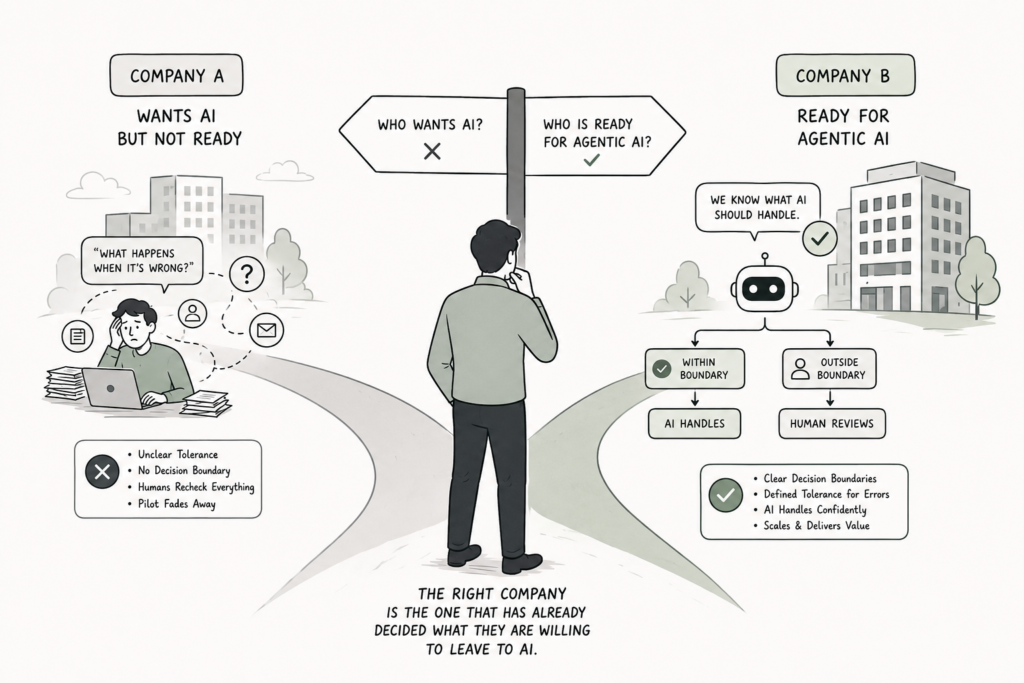
They weren’t impressed by faster response times or lower support costs. Throughout the meeting, they kept returning to one question: “What happens when it’s wrong?”.
At the time, it felt like unnecessary caution. Three months later, Company A’s pilot quietly died. Nobody officially cancelled it.
The AI was still technically running, but people had slowly gone back to checking every response before it reached the customer. One human review became two. Two became every ticket. Eventually, the workflow looked exactly the way it had before the AI arrived.
Company B looked completely different.
Their AI agent was handling nearly half of their support volume without anyone checking every reply.
Same product and category but completely different outcome.
So what actually changed?
The difference was something much quieter.
Company A wanted AI.
Company B had already decided what they were willing to leave to AI. That realization changed how I think about selling Agentic AI.
Selling Agentic AI Is Not Selling Software
For nearly twenty years, enterprise software followed a simple promise. Help people work faster. Even the first generation of AI copilots followed the same principle.
The final checkpoint always belonged to a person. That’s why software adoption rarely became a philosophical debate.
The question was usually simple. Will this save us time?
Agentic AI changes the question. Are we comfortable letting software make this decision before a human sees it?
It’s a trust question. Think about an AI procurement agent. You’re not asking the procurement team to automate emails. You’re asking them whether software should negotiate with suppliers within predefined boundaries.
Think about an AI finance agent. You’re asking someone to trust software with approvals, reconciliations, and financial actions that were previously protected by multiple human checkpoints.
Do you see the difference?
The software didn’t just become smarter. The responsibility changed. And the moment responsibility changes, the buying process changes with it.
Read More About How to Sell Agentic AI to CXO?
What Companies Are Actually Buying
Most founders believe they are selling intelligence. I don’t think they are.
Every Agentic AI product is asking a company to let go of a manual checkpoint that has existed for years. That’s a much bigger decision than buying another software application.
Go back to Company A.
The problem wasn’t that the AI made mistakes. Every employee makes mistakes. The problem was that nobody had decided what an acceptable mistake looked like before the pilot began.
The first incorrect refund created uncertainty → Uncertainty created doubt → Doubt brought humans back into the workflow.
The AI never failed but the trust did.
Company B had a different conversation before the pilot even started.
Anything below a certain threshold? The AI handles it.
Anything above that threshold? Escalate it to a human.
Notice what happened.
The company had already made the difficult decision. The software was simply executing it. That’s why one pilot disappeared while the other became part of daily operations.
So, How Do You Find Companies That Are Ready?
This is where most GTM teams continue using traditional filters such as Industry, Revenue, Employee count, Geography.
Those things still matter. But they won’t tell you whether the company is ready to trust Agentic AI. Instead, I look for something completely different.
I look for signals.
The first signal is whether the company has already tried solving the problem by hiring more people.
Growing teams eventually reach a point where adding more headcount no longer improves the workflow. That’s usually when businesses become willing to rethink how the work itself gets done.
The second signal is whether they’ve already experimented with rules-based automation.
They know that real business processes rarely fail because of rules, but it does because reality refuses to follow them.
The third signal is my favourite. Ask one simple question.
“What does an acceptable mistake look like?”
If the room goes silent, they’re probably still early. Because they haven’t yet agreed on where human judgment should end and software should begin.
The fourth signal is the buying committee itself.
If only the operations leader is excited, I become cautious. If operations, finance, risk, compliance, and IT are already part of the conversation, I know the company understands the decision they’re about to make.
The fifth signal, I look for urgency.
Not the future one. Present urgency.
Is there already a queue growing every morning?
Is manual work already slowing the business down?
Is hiring no longer fixing the problem?
Companies without urgency will always choose caution over autonomy. And honestly, they should.
The Hidden Shift Most Founders Miss
I think many founders still believe they’re selling automation.
But if you are keen about hidden details, they’re actually helping companies redefine where humans stop and software begins.
That’s a very different conversation. One is about efficiency. The other is about organizational trust.
It has to be observed.
Bottomline
The market isn’t short of companies interested in Agentic AI.
What’s actually scarce are companies that have already had the internal conversation about what they’re willing to leave to AI.
That’s the company you’re looking for. Because companies don’t become ready for Agentic AI the day they see your product.
They become ready the day they decide where they’re comfortable letting software take over.
Find companies that have already reached that decision. The rest of the sale becomes much easier.
If you’re an AI founder looking for expert advice on how to sell your product, schedule a quick strategy call with Venkatesh Majji.