
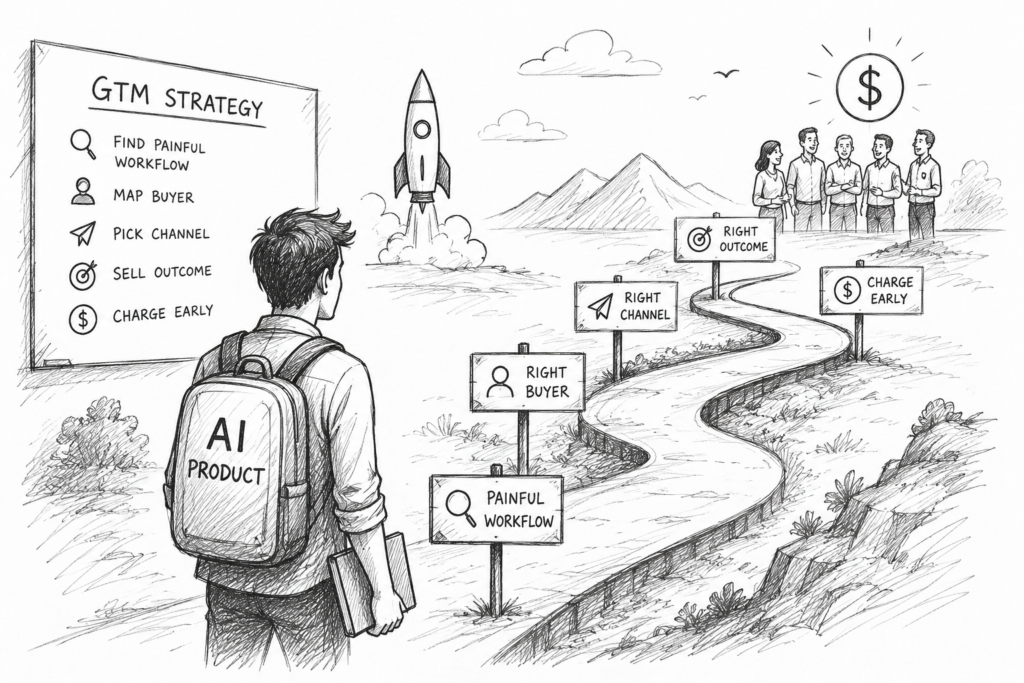
GTM Strategy to Get Early Paid Customers for Any AI Product.
There is a classic trap that complicates getting early paid customers for today’s AI products: founders confusing curiosity with demand. As an AI product founder, you built something that you believe will solve a problem in the market. You offered it to specific users to try it out. They tried prompts and said “it’s amazing.” But when it comes to the question, “will they pay $49/Month for it?” Only silence becomes the loudest answer thereafter.
Too much applause but no Invoices 🙁
Then, what is the best way to get early paid customers for any AI Products? What is the best GTM strategy? How to move from 0 customers to the first 10 paid customers for your AI product?
Selling AI is not Selling SaaS
If you think your AI product is just an upgrade of an existing SaaS stack so you can take the SaaS route, you are losing a considerable amount of money over here. Because selling SaaS usually boils down to “why should I choose this over that”. SaaS enters the buying committee that is already aware of the problem and wants to solve it by any means. For example, everybody knows sales teams need a system to manage customers or finance teams need a system to manage accounts. The problem here is crystal clear.
So, what changed? AI products today are creating new categories, new workflows, and new habits.
Here’s how today’s reality looks like for AI products:
Previously it was just that I needed a better SEO tool. Today it’s about Should AI write and manage my SEO workflow?
Previously it was just that I needed a better customer support system. Today it’s about Should an AI agent resolve tickets without my team?
So if AI changed the product but not the buyer, where does GTM start?
It starts at “Finding one painful workflow + Exact person who owns that Workflow.“
Find the Painful Workflow
Your first customer is not the person impressed by your AI. Your first customer is the person tired of doing the job your AI replaces. Most founders get it wrong when they are trying to define their category. It ends up like “I have created an email assistant, hence my Ideal Customer Persona (ICP) is a marketing team.” Do you see how wide it went? You have created a tool for one specific task email assistance but all suddenly your target itself becomes a marketing team? Marketing and sales is not all about email.
Go specific. Start with the painful workflow such as:
“A content specialist at a series A SaaS company spends 10 hours every week converting webinars into blogs, emails, and social posts and the marketing manager wants to improve the production without increasing the headcount.”
Now, they are the ones who are willing to pay to remove their painful Monday morning chaos.
Map Buyer
Now, you have found your painful workflow. Now you have to map the buyer. But remember, even in SaaS time, the end user of your product is not always the buyer.
For example: you’ve built a coding assistant. Your end user is a developer, obviously because he feels the pain and influences your product to whom he reports to. The engineering leader buys it and the CTO approves the budget.
What if it’s an AI sales rep? Your buyer end user is the sales team. And the buyer is a sales VP who wants a good looking pipeline and the budget approval stays with the Founder or the CRO.
Here’s the simple trick to map your buyers. Sit and write answers for these questions:
- Who feels the pain?
- Who owns fixing the pain?
- Who controls money?
Pick Distribution Channel
Founders love talking about channels because channels feel like GTM. One morning they wake up and decide I will do LinkedIn and email Outreach to reach the buyer. Just another common mistake in the wild.
Imagine, a developer looking to get code compilation suggestions, where is the first place you can find him? Not LinkedIn. He will be surfacing on GitHub or some technical communities.
How about selling AI Sales assistants? Where are your buyers? LinkedIn, sales communities, founder networks, revenue podcasts or events.
Before choosing your GTM channel, answer these:
| Question | Your Answer |
| Who feels the pain daily? | |
| Where do they search when this problem happens? | |
| Who do they trust for solutions? | |
| Which communities are they already part of? | |
| Who influences their buying decisions? | |
| What content do they consume before buying? |
Your channel is where your buyer already spends time and finds solutions.
Sell Outcome
Understand this: Intelligence is your technology. Outcome is your product.
Most AI founders lose the buyer here because they are still excited about the technology they built. They start with something like our AI agent can analyze thousands of documents or write 100 personalized emails in under minutes. And the buyer still asks what changed in my business.
A sales leader buys because they want more qualified meetings without hiring 10 more SDRs. A customer support leader buys because customers get answers faster without increasing support costs.
That’s the nuance you need here.
Rather our AI writes 100 emails, say, your sales team books 30% more meetings without increasing headcount.
Charge Early
Now it’s time to charge for the outcomes you are selling.
This is what happened today. Most founders delay charging because they think one more feature will finally convince users. They collect feedback, feature requests, testimonials and start building 50 more features before selling what they already have with them.
If your AI saves a recruiter 10 hours every week, or if it helps a sales team generate pipeline faster, there is already value exchange happening. There is no wrong in charging for that.
Put a charge for the outcome.
Bottomline
The first 10 customers are not buying your most advanced AI product. You found a painful enough problem they have today and solved it for them.
If you look close enough, AI has never changed how businesses buy. They still buy outcomes, solve problems, and better versions of their existing reality.
The AI companies winning today understand that. They know whose problem they solve, where to reach them, and why they should buy now.
——————————————————————————————————–
At Elephant Edge, we work with AI and B2B technology companies building their GTM engine for markets like the US. From finding your ideal buyers to designing the right sales motion, we help founders move from building products people try to building companies customers pay for.
Book a quick call to understand your GTM