

How to Sell AI-powered HR Tech in 2026?
Why CHRO Loves Your HR Tech But Your Deal Still Dies?
Honestly, selling HR Tech today is weird. Because everyone is affected by it, but not everyone buys it.
If you take a step back and see the evolution of how HR Tech stacks have been sold in the past in comparison to the present, you will eventually end up with a question: who is the real buyer?
Your product might solve a real problem and the demo might impress everyone. But that doesn’t mean everyone has the same reason to buy it.
Today, HR Tech isn’t built to help just one part of the business, but to run the entire landscape. Be it the classic ATS, or the modern AI Interview platforms, selling HR Tech touches every nook and corner of a business: HR department, TA, employees, finance, legal, IT, etc.
The biggest challenge in selling HR Tech in 2026 is that everyone already agrees that your tech matters. But every stakeholder sees a different problem inside the same product.
So, what makes selling HR Tech so complicated?
Let me tell you about an employee benefits company I worked with four years ago.
The tech helps in employee benefits and productivity improvement through personalized wellness recommendations from mental health, diet, workout, supplements to doctor consultation for each employee.
That’s great. Healthy Employees. Better Productivity. Great Workplace. It’s an all-in-one platform. Of course, HR will buy, no doubt.
Well, this is where it gets interesting.
To our surprise, the first meeting broke the assumption of easy selling.
Of course, the CHRO loved it until the rest of the buyers joined the meeting. As soon as the CFO entered the conversation, we were not talking about employee benefits anymore. He wanted to know how we were quantifying the productivity improvement and how we were justifying the ROI from the investment we were asking for. Then Legal entered and the questions turned into: What kind of employee health data are we collecting? And do regulations allow it? Then the Head of Engineering entered and the questions were: Where does the data live? Is your tech capable of integrating with existing systems?
The CHRO still liked the product. But without everyone aligned, the deal quietly moved to next financial year.
This is the reality of almost every HR Tech category.
Sell an ATS and HR might see faster hiring. But hiring managers see candidate quality. Finance sees cost per hire. Legal sees hiring compliance.
Sell payroll software and HR might see operational efficiency. But finance sees accuracy and cost control. Employees see trust in getting paid correctly. Legal sees compliance.
Sell performance management software and HR might see better employee development. But managers see another process they need to follow. Leadership sees whether it actually improves business performance.
One thing is clear here. When it comes to HR Tech, the product is the same, but every buyer is buying a different outcome.
But has it always been this messy?
Nope. There was a time where selling HR Tech meant winning only the HR team.
How HR Tech Was Sold Before?
One thing HR Tech companies promised from the beginning: “Give Your HR Team Super Powers.” The wider picture was to make HR teams’ work a little easier; move away from spreadsheets, reduce manual work, centralize employee data, make HR fast, and make the HR process seamless for everyone in the organization.
Even before, other teams existed and the impact was visible outside HR. But ownership stayed inside HR. HR Directors or CHROs carried the deal.
Now what changed?
Previously it was: Make your HR team more efficient. Today, the promise is to make the entire company efficient. Everything else came because of that: new buyers, deeper questions, longer sales cycles. The moment HR Tech promised company-level outcomes, company-level people entered the buying decision.
That’s how you got the room crowded. And HR Tech itself moved out of HR.
Now your sales motion has to follow the same path. You cannot walk with the same HR pitch anymore.
But if you decide to walk in with a different pitch, first understand who is sitting in the room.
3 Things to Understand in Selling HR Tech Today
- The Marketplace.
- The Buyer.
- What Matters to Them.
The Marketplace:
SMB (Small and Mid-Size Business)
Have a workforce somewhere around 50 to 200. For them, speed matters more than complexity here. So they only care about if your tool will help remove their headache.
Your usual HR Transformation story won’t sail here. Because the business owner doesn’t wake up every day thinking, “How do I digitally transform employee experience?” They wake up thinking, “Why did my HR spend 3 hours on this task?”
You need to show them your tech will save time, reduce manual work, hire faster, and avoid mistakes.
In your battle card here, the founder, HR manager, or business owner might be the same person making the decision.
Mid-Size Businesses
The workforce will be around more than 200 but less than 1000. This is not the small room anymore but not so big with unlimited resources. This is where you can prove your tech can scale.
You are not selling HR transformation here as well and at the same time you shouldn’t sell “make HR faster” as well.
Because the mid-size company wants to run the business better today than it was yesterday because they are on their way to becoming an enterprise tomorrow.
The HR leader owns the pain, but the decision no longer stays only with HR.
Your narrative should answer the buying committee questions.
- HR: Can this support our next stage of growth?
- Finance: Can this investment justify itself?
- IT: Will this fit our systems?
- Business leaders: Will my team actually use this?
In a nutshell, you need to prove that your tech will help them scale tomorrow. That’s your mid-market win.
Enterprises:
Ah… Classic.
You wanted to sell transformation. Congratulations. The people responsible for transformation are now your buying committee.
The key thing to remember while approaching enterprises is: “Can this change thousands of employees without breaking anything?”
The decision-making authority spreads to every department head. But, you just need to convince the CHRO to get a meeting with them all in one room.
Because sometimes:
- CHRO is the champion but the CFO controls the budget.
- CIO can block because of integration & security.
- Business units can influence adoption.
The smartest move here is to make the CHRO the hero. Enable your champion with enough ammunition to defend your product in the boardroom and justify this initiative to the CFO, CIO, and CEO.
The champion may change in an enterprise based on what product you bring in. If it’s finance, then CFO. Payroll, CHRO. Security, CIO.
Regardless of the champion, your part of enabling them stays constant.
That’s your enterprise play.
Ok… now how do you help your champion convince everyone when you are not in the room?
Meet the 3 Types of Buyers and What They Want.
The Economic Buyer
An economic buyer can be the CFO, CHRO, or CEO. The designation changes based on your deal size. Because these buyers control the decision and the budget.
They care about: Business impact, ROI and strategic priority. And they are the ones who think “Should we spend money on this?” And you need an answer that convinces them that they should.
The Technical Buyer
If you have built an advanced workforce analytics platform that connects employee data across multiple systems, these technical buyers become critical voices in your deal. Because they care about all the tech stuff like integration, data, security, and implementation. Their designations are usually CIO, CTO, & CISO.
They are not the ones that usually say Yes to your product if the CHRO comes up with it. But they have the technical authority to say No if they feel your product might break their world.
The Influencers
A recruiter using your ATS every day can become your strongest internal voice. Or a manager tired of performance review chaos can push adoption. They own reality rather than the budget.
These people are sometimes the unexpected champions. Because they are the end adopters of your product and influence the decision inside the organization.
Bottomline
The challenge in selling HR Tech is proving how your technology creates value for every person sitting inside the buying room. And the companies winning this market understand one simple thing:
They sell the right outcome to the right buyer.
Because the future of HR Tech belongs to companies that understand both sides of the equation: the technology they are building and the people they are selling to.
At Elephant Edge, we work with B2B technology companies building their GTM engine for markets like the US. From identifying the right buyers to creating the sales motion around them, we help founders move from building great products to building repeatable revenue.
Let’s map your HR Tech GTM journey.
Schedule a Quick Call With Our Fractional VP of Sales.

Effective Sales Execution: The Enormous AI Advantage for CEOs of Small Sales Teams
It’s 9 PM and you’re still in the CRM. Following up on a proposal your…

From Chaos to Clarity: 3 Things AI Will Do for SMB Revenue Teams
There’s an awkward stage in the life of an SMB. You’re doing $3 million, maybe…
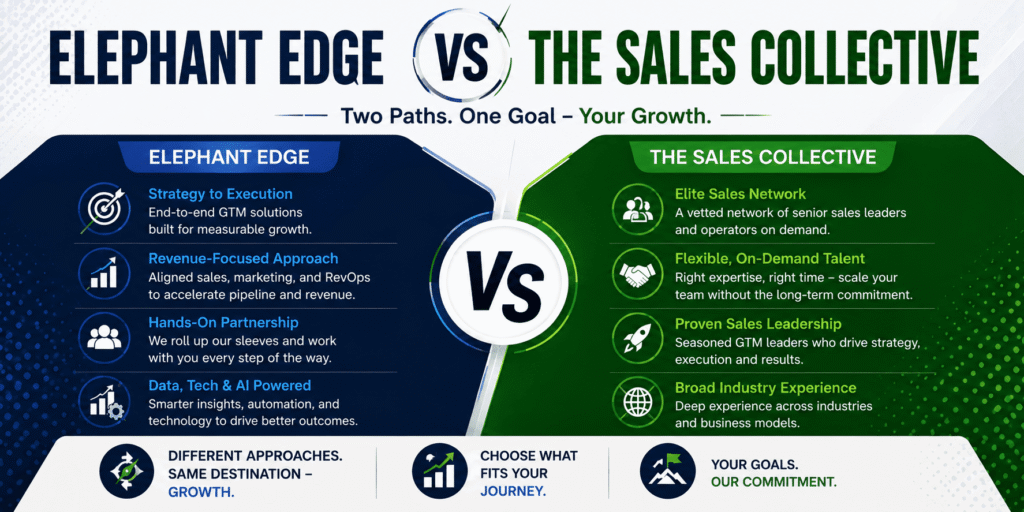
Elephant Edge vs The Sales Collective
Overview: Optimizing Your Sales Team vs Building Your Sales Engine Most companies believe growth problems…
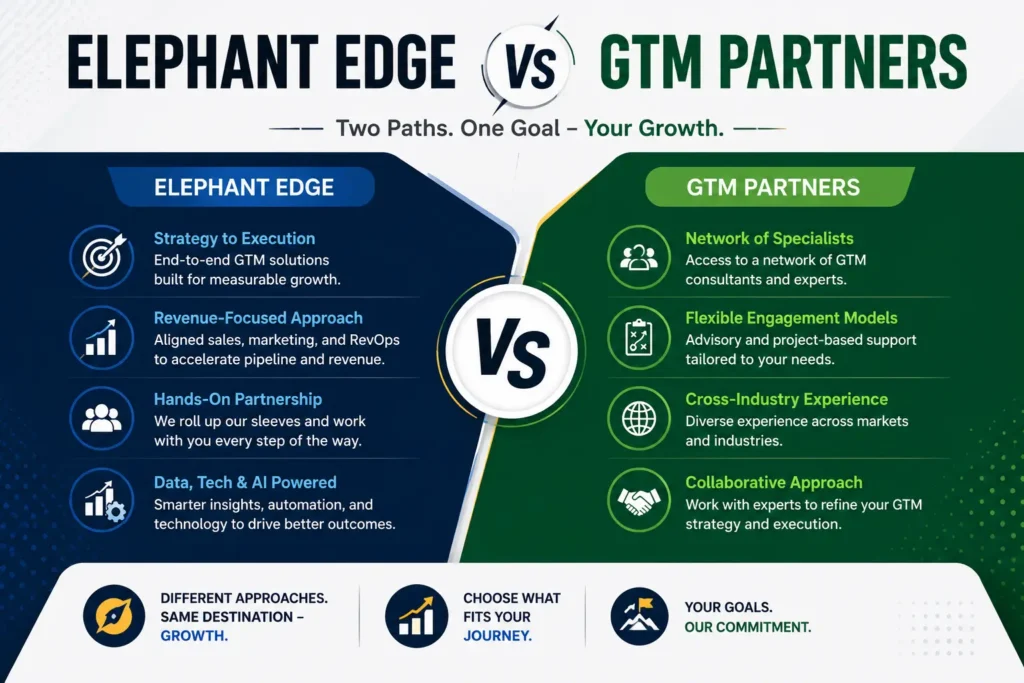
Elephant Edge vs GTM Partners
Overview: GTM Transformation vs Building Your First Revenue Engine Every growing technology company eventually reaches…
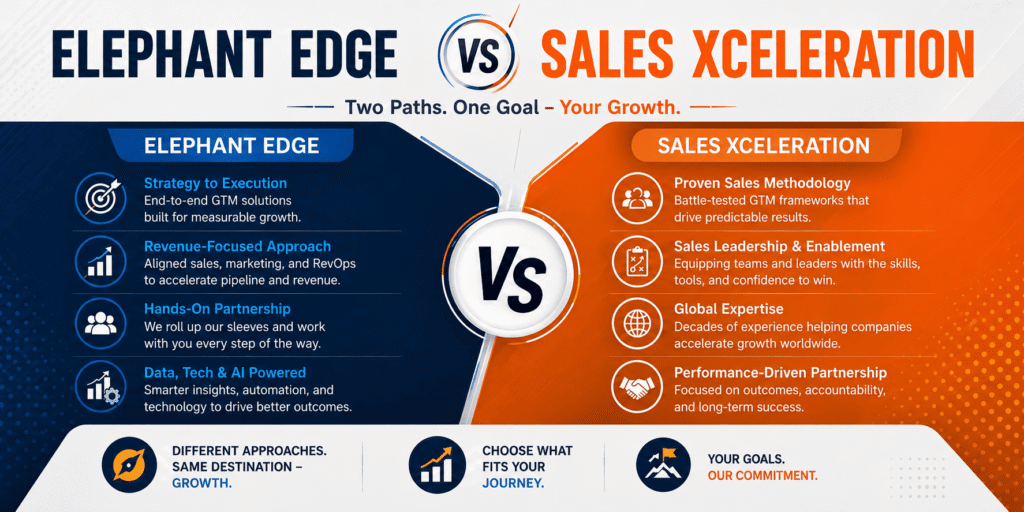
Elephant Edge vs Sales Xceleration
Overview: Managing Your Sales Organization vs Building Your US Revenue Engine Every company reaches a…
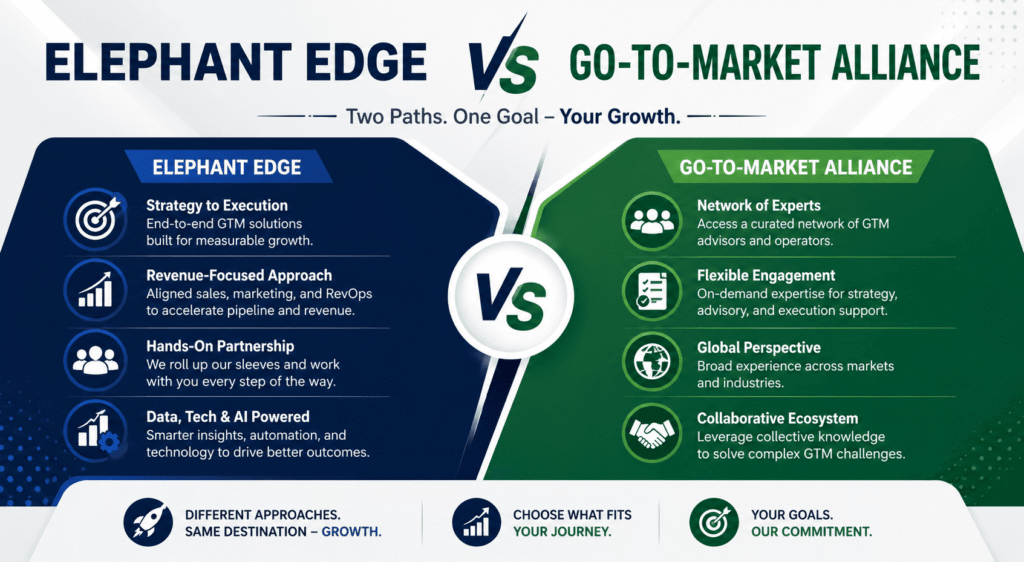
Elephant Edge vs Go-to-Market Alliance
Overview: Learning GTM vs Building Your GTM Engine Every technology company eventually faces the same…