
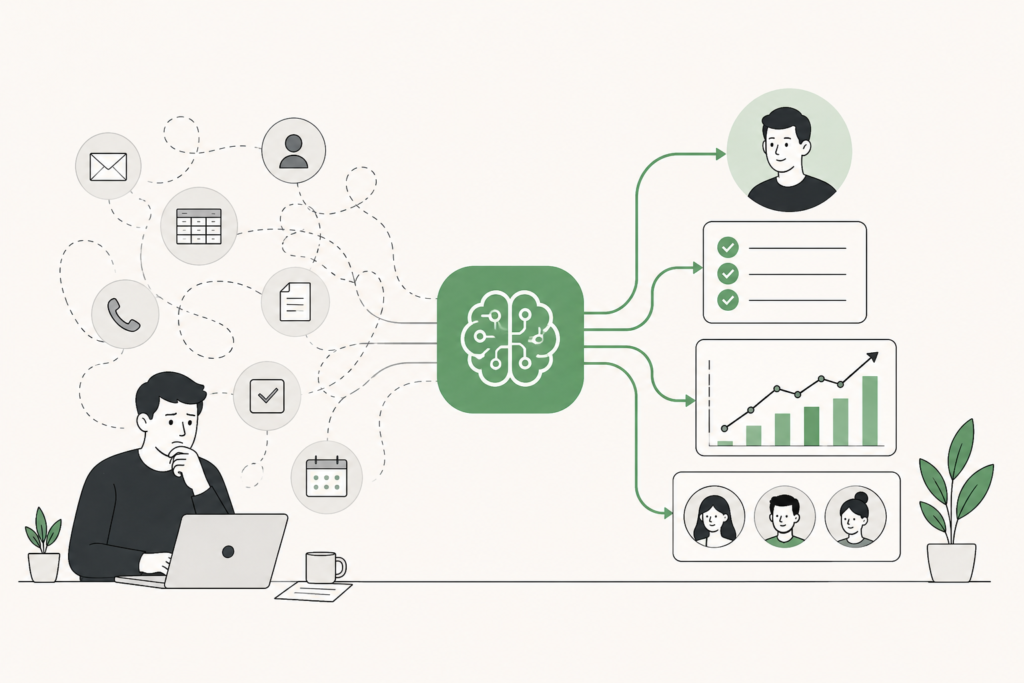
It’s 9 PM and you’re still in the CRM. Following up on a proposal your AE forgot to send. Answering a prospect’s email yourself because nobody else knows the account well enough to answer it right. Tomorrow you’ll do it again, plus the board deck, plus the two interviews for the AE role you’ve been trying to fill for six weeks.
You started the company to build something. Most nights, you’re the fourth salesperson on a three-person team.
That’s not a time management problem. It’s a structural one, and until recently, there was no way out of it. A three-person sales team has always lost to a thirty-person sales team on sheer execution: more calls, more coverage, more follow-up, more accounts worked at once. Size won. It was that simple.
It isn’t anymore.
The real disadvantage was never headcount
Big sales orgs execute through layers. The CEO or CRO decides something, a VP of Sales translates it, regional managers translate it again, individual reps execute a version of it three or four translations removed from the original decision. Changing a message, a target segment, or a qualification bar takes weeks to show up in the field, and by the time it does, it’s been reinterpreted at every layer along the way.
A three-person team has no layers. What you decide, the team can execute the same day.
That used to be a disadvantage, because a CEO’s attention doesn’t scale. You could make the decision instantly, but you couldn’t personally research every account, write every message, run every follow-up, and still close deals. The bottleneck wasn’t the decision. It was everything after it.
AI removes everything after it.
An AI system encodes your judgment, the ICP you know in your head, the buying signals you’ve learned to spot, the messaging that’s actually worked, and runs it across every account without a translation layer in between. What used to take a thirty-person org to execute now takes a system you built once and keep improving. The CEO who used to lose on execution now wins on it, because the distance between the decision and the result just collapsed to zero.
The data backs the shift, not just the argument
This isn’t a small-team pep talk. The Federal Reserve’s own data shows small firms adopting AI faster than large ones for the first time on record, after enterprise adoption growth flattened out. Small firms don’t need six layers of approval to try something, a leader can test a new workflow with the team this week and know by next week if it’s working. A large sales org needs a budget cycle to do the same thing.
That gap compounds. The businesses pulling ahead right now aren’t necessarily the biggest. They’re the ones that moved past using AI for the occasional email and actually built it into how the team runs.
What this looks like for a CEO who’s also the closer
Picture a Tuesday. A competitor changes pricing. In a thirty-person sales org, that change sits in a review meeting, then a messaging update, then manager training, then it finally reaches reps, three weeks later, if it reaches them cleanly at all.
You update your system Tuesday afternoon. By Wednesday morning, every account in your pipeline is being approached with the new positioning. Your three-person team just outmaneuvered an org ten times its size, not because your team worked harder, but because there was nothing standing between your decision and its execution.
This is the advantage that headcount used to buy, and now doesn’t have to.
The single point of failure disappears too
Small teams have always run on people, which means they’ve always run on people’s bandwidth. One AE takes a week off, follow-ups stall. The CEO gets pulled into a fundraise, prospecting slows. The team is strong until someone’s out, and then it isn’t.
A system doesn’t take a week off. It doesn’t forget the fifth follow-up because the fourth one didn’t get a reply. It runs the same qualification logic on the hundredth account as the first one. For a small team, that consistency is worth more than almost any other advantage AI offers, because inconsistency was always the tax small teams paid for being small.
Where CEOs get this wrong
Most will treat this as a tools problem. They’ll add an AI email writer, then a meeting summarizer, then a chatbot for the website, and call it done. None of that closes the execution gap. Point tools automate a task. They don’t remove the translation layer between what the CEO knows and what the market experiences.
The CEOs who actually capture this advantage build a system, not a tool collection: one place where the ICP, the signals, the qualification logic, and the messaging live, connected end to end, so a decision made once shows up in every account without anyone in between having to interpret it. That’s the difference between an AI-enabled sales team and one that just bought some software.
The advantage compounds if you move first
The businesses already ahead aren’t waiting for a perfect AI strategy document. They picked the three or four things a person on their team does manually every week and built a system around those first. Then they did it again with the next three or four.
That’s available to a three-person sales team the same way it’s available to a thirty-person one, except the three-person team can actually finish building it in a week, not a quarter.
You didn’t start this company to spend your nights in the CRM. The team you have doesn’t need to get bigger for the company to execute like it already is. It needs a system that lets your judgment reach every account without you personally having to be in the room for it.
That’s the advantage a small sales team has right now, and most competitors still don’t know it exists.