
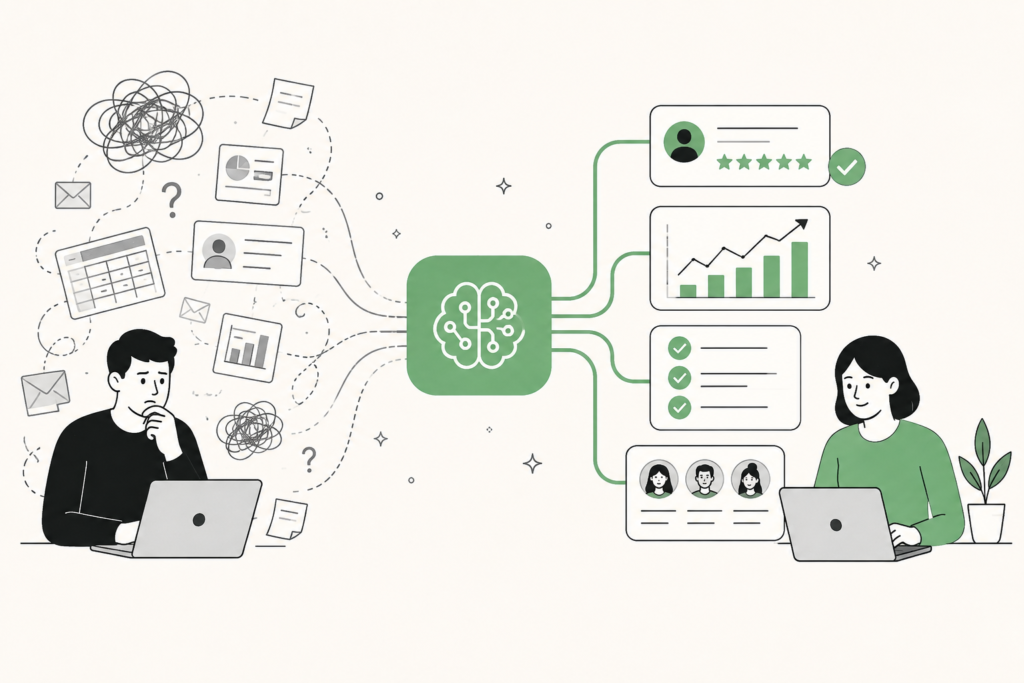
There’s an awkward stage in the life of an SMB.
You’re doing $3 million, maybe $5 million in revenue. You have a sales team. You have a marketing team. You have a CRM, more sales tools than anyone can remember, dashboards, and a weekly pipeline meeting. Someone probably says “RevOps” every now and then.
You’re also spending close to $1 million a year on sales and marketing to make all of this run.
But you don’t have a GTM operations team. And you don’t have a GTM Engineer.
So the company sits in an uncomfortable middle. The founder is no longer supposed to be involved in every deal, but the sales team still needs the founder’s instincts. Marketing generates leads, sales complains about lead quality. The CRM has thousands of contacts and nobody trusts the data. The salespeople are busy. The pipeline isn’t.
When the quarter starts looking soft, everyone has the same meeting: “We need more pipeline.” So marketing runs another campaign, sales increases outreach, someone buys another data platform, the SDRs send more emails, the sales manager asks everyone to update Salesforce. Three weeks later, everyone’s exhausted and the pipeline looks the same.
That cycle is not a strategy problem. It’s a structure problem. And it’s the reason AI is about to change this stage of company more than any other.
Not because AI can write an email, your salespeople can already write emails. Not because AI can summarize a meeting, that saves time but doesn’t change the business. AI becomes the missing GTM layer between strategy, people, and revenue. For a company running a $1M sales and marketing budget with 3 or 4 salespeople and no GTM ops function, that layer is the difference between adding more people and getting more output from the team already in place.
The timing backs this up. Salesforce found that 75% of SMBs globally were already experimenting with or using AI, with adoption even higher among growing SMBs at 83%. Among SMBs already using AI, 91% said it boosts revenue.
Here are the three things AI will do inside every SMB revenue team at this stage, whether the company is losing 20-30% of revenue to an underperforming team, missing a pipeline solid enough to grow on, or trying to grow 30-40% without doubling headcount.
1. AI will turn tribal knowledge into a system
Right now, the best salesperson on your team knows things that aren’t in the CRM. Which accounts are worth pursuing. Which job titles actually buy. What a good prospect sounds like on a call. Which signals mean there’s an active project. Which objections are real and which are a polite no. Which industries convert, and which accounts look perfect on paper but never buy.
The company doesn’t own that knowledge. The salesperson does. That is why a sales team can look healthy on an org chart and still underperform. Four salespeople are not four copies of your best salesperson. They are four different interpretations of how selling should happen, and that gap is what drains 20-30% of revenue out of an underperforming team.
AI closes that gap by converting the knowledge into infrastructure, not documentation. The founder’s definition of an ideal customer becomes an ICP model. The sales team’s buying signals become an account-scoring model. Winning discovery questions become qualification logic. Successful messaging becomes a reusable framework. Objection patterns become sales intelligence. Past wins become training data for the next opportunity.
This isn’t AI writing a playbook. It’s the playbook becoming executable. A PDF in Notion doesn’t generate pipeline. A system that continuously applies ICP, qualification criteria, buying signals, and messaging logic does.
The data behind this is direct. Salesforce found that 74% of growing SMBs were increasing their investment in data management, compared with 47% of declining SMBs. Growing SMBs were also twice as likely to have an integrated tech stack, 66% versus 32%. AI does not fix a messy revenue process. It amplifies whatever system it’s given. Bad data produces bad decisions faster. Good data produces leverage.
AI’s first job in an SMB is not replacing the salesperson. It’s putting the organization’s best sales knowledge in front of every salesperson, every time.
2. AI will turn “we need more pipeline” into a pipeline machine
Most companies start their AI adoption here, and most start too narrow. They automate email. Then LinkedIn. Then lead enrichment. Then meeting notes. Then CRM updates. That produces five automated tasks. It does not produce an automated sales engine. The difference is the whole point.
A pipeline does not begin with an email. It begins earlier: which companies should we pursue, why now, who inside the company matters, is there evidence they actually have the problem we solve, how should we approach them, what happens if they don’t respond, when should a human get involved.
That entire chain is becoming one connected system:
Targeting → find the right accounts. Signals → monitor hiring, funding, leadership changes, product launches, technology adoption, and other indicators of demand. Enrichment → build context around the company and the people inside it. Qualification → decide whether the account deserves human attention. Personalization → create messaging based on the account’s actual situation. Execution → run the outreach. Nurture → keep the conversation going when the buyer isn’t ready yet. CRM → capture what happened. Human → bring the salesperson in when a real commercial conversation is possible.
This is not “AI writes my emails.” This is a pipeline machine, and the results are already measured. McKinsey found that one company using AI to prioritize opportunities, generate research and scripts, and handle straightforward outreach achieved 40% higher conversion rates and 30% faster lead execution after implementation. McKinsey also found that high-performing sales reps spend significantly more time with customers than lower performers, and that automating administrative work frees sellers to focus on opportunity identification, negotiation prep, and customer interaction.
The goal is not more sales activity. It’s less of the activity that doesn’t generate revenue, and more of the activity that does.
The buyer has already made this shift. Forrester reported in January 2026 that 94% of business buyers now use AI in their buying process, up from 89% the year before, and that twice as many buyers named generative AI or conversational search as a more meaningful information source than any other. The buyer is using AI to research the company. The sales organization has to use AI to understand the buyer. That asymmetry is what most SMBs still haven’t closed.
3. AI will give your existing sales team the leverage of a GTM engineering function
The instinct at this stage is “we need another salesperson.” Sometimes that’s true. Just as often, the company doesn’t need another salesperson. It needs a better system around the salespeople already there.
Picture four salespeople. One spends Monday morning researching accounts. Another spends Tuesday cleaning CRM data. Another spends Wednesday manually building lists. Someone spends Thursday chasing follow-ups. Friday becomes pipeline review. None of them are spending enough time with customers, and none of them are doing it by choice.
Now picture those same four people supported by a GTM system. It identifies accounts, watches for buying signals, researches the company, identifies decision-makers, scores the opportunity, creates the context, runs the first layer of outreach, nurtures the account, updates the CRM. When the opportunity crosses a threshold, the salesperson gets the handoff: not “here’s another lead,” but “here’s an account worth your time, here’s why now, here’s the problem we’re seeing, here’s who matters, here’s what we’ve tried, here’s how they responded, here’s what to talk about.”
That changes what the organization needs from its people. A salesperson stops being a researcher, data analyst, SDR, CRM administrator, and relationship manager at once. They become a salesperson, full time.
This is the GTM Engineer’s job. Not another RevOps hire. Not another CRM administrator. Not someone producing another dashboard. A GTM Engineer builds the machine that gives the commercial team leverage: connecting data, designing workflows, building agents, creating qualification logic, automating handoffs, testing messaging, monitoring performance, improving the system against what the market actually does.
The role exists because the old GTM stack was built for humans doing the work by hand. The new GTM stack requires someone who knows how to make humans and AI operate as one system.
McKinsey’s latest research draws the same line. The opportunity is not isolated generative AI tools. It’s agentic AI applied to end-to-end sales workflows, what McKinsey calls a new commercial operating system. That is the shift: from salespeople plus tools, to salespeople plus a GTM system.
What this means for a $1M sales and marketing budget
There are two old options.
Option one: hire more people. Add two SDRs, another AE, RevOps later, more management, more software. Hope revenue grows faster than complexity.
Option two: keep the team small and accept that the founder stays involved in everything.
AI removes the need to choose. It builds a third option: a GTM system around the people already on the team.
If the sales team is underperforming, the first question isn’t who to let go. It’s which part of the process is broken.
Is the ICP unclear? Are the wrong accounts entering the pipeline? Are buying signals being missed? Are salespeople spending too much time researching? Is qualification inconsistent? Are follow-ups falling through? Is marketing generating leads that sales doesn’t trust? Is the CRM full of data nobody uses? Are the best salespeople spending half their week doing work that doesn’t require a salesperson?
These are system problems. AI solves system problems.
The real opportunity is not AI adoption
Most SMBs will get this part wrong. They’ll buy an AI SDR, then an AI meeting assistant, then an AI email writer, then an AI CRM assistant, then another AI platform. Six months later, they’ll have an AI-powered version of the same chaotic sales process. That’s not transformation. That’s tool accumulation.
The real work is redesigning the revenue process around what machines do well and what humans do well.
Machines do this well: scale, research, pattern recognition, data processing, monitoring, repetition, qualification, personalization, follow-up.
Humans do this well: judgment, discovery, trust, negotiation, problem solving, relationship building, commercial strategy.
The model is not AI versus humans. It’s AI doing the work around the human. That’s System-Led Sales: the system finds the opportunity, builds the context, qualifies it, and nurtures the account. The human steps in when the conversation is worth having. The system learns from what happens next.
From chaos to clarity
The $3 million to $10 million stage is where SMBs hit an invisible ceiling. The company has proven customers will buy. The founder has proven the market exists. The sales team has proven deals can close. What the company hasn’t built yet is a machine that reproduces those results without the founder in the room.
That’s the gap AI closes.
A $5 million company does not need a 20-person sales org to become a $7 million company. It needs its existing four salespeople to be dramatically more effective. A company losing revenue to an underperforming team does not need another hire. It needs to fix the bottleneck the team is operating inside of. A company struggling with pipeline does not need more activity. It needs better targeting, better signals, better qualification, better execution. A company trying to grow 30-40% does not need 30-40% more people. It needs more leverage from every person already on the team.
That is the promise AI delivers to SMB revenue teams: not more sales activity, more revenue per human.
The companies that build this first will look different from the sales organizations built over the last decade: fewer manual workflows, fewer handoffs, less admin work, better data, more intelligent systems, and salespeople spending more of their time doing the one thing no system will ever fully replace, having a good conversation with a customer.
That is how SMBs move from founder-led chaos to scalable revenue. Not by hiring more people to manage the chaos. By building a system that removes it.