
Top 10 Agentic AI Companies to Watch in GTM & Sales Space in 2026
Every week another Agentic AI company launches sales assistant, AI researcher, copilot claiming it will “revolutionize sales.” But after a while, everything begins to sound the same.
A few months ago, I sat down to understand this market a little better. My intention was simple. Find a handful of interesting companies building Agentic AI for Sales and GTM.
Instead, I found myself staring at something much bigger. These companies weren’t building the same product. They weren’t even competing in the same category. They were quietly redesigning different parts of the modern GTM organization.
One company wants to replace prospect research.
Another wants to become your SDR.
Someone else wants to own customer signals before your sales team even notices them.
A few are rebuilding CRM around AI agents.
Another believes the future of selling begins long before the first cold email is written.
That’s when I realized something.
Also Read:- How to Find Companies That Actually Need Agentic AI?
Maybe we have been looking at this market the wrong way.
The interesting question isn’t… “Which Agentic AI company is the best?”
The better question is… “Which part of the GTM organization is each company trying to reinvent?”
Because for nearly two decades, B2B sales evolved one software category at a time. Every category made the salesperson slightly more productive. Agentic AI is taking a different path.
Instead of building better software for salespeople, these companies are beginning to ask something much more fundamental.
Should this job exist in its current form at all?
That’s a fascinating shift. Because the future of GTM may not belong to companies building the smartest AI.
It may belong to companies that understand one workflow deeply enough to redesign it from the ground up.
Think about how a modern sales organization operates today.
Lead Generation → Prospect Research → Account Prioritization → Personalized Outreach → Meeting Booking → Sales Conversations → Proposal & Deal Support → Revenue Intelligence
Traditionally, every one of these stages depended on people working with software.
Today, Agentic AI companies are asking a completely different question.
What if software became the teammate instead of the tool?
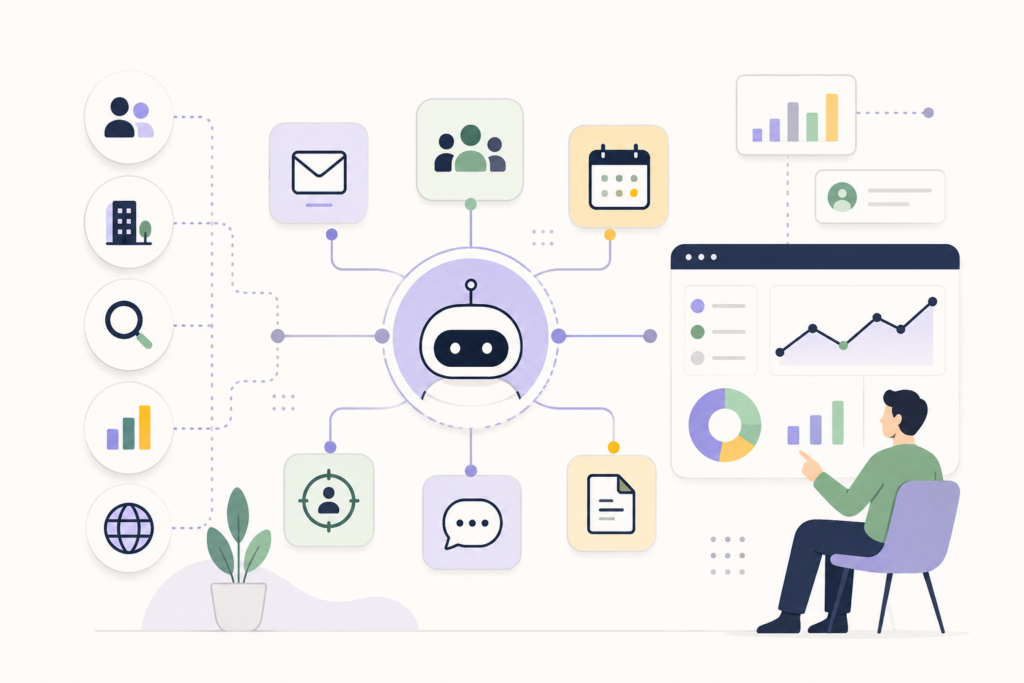
Mapping the Agentic GTM Landscape
Instead of ranking these companies from one to ten, I found it more useful to group them by the workflows they’re transforming.
| GTM Workflow | Companies Leading the Shift |
| Prospect Research & GTM Engineering | Clay, Common Room |
| Autonomous SDRs & Outbound | 11x, Artisan, Landbase |
| Buyer Intent & Website Signals | Koala, Warmly |
| Sales Execution & Revenue Intelligence | Attention |
| Enterprise Agent Platforms | Salesforce Agentforce, HubSpot Breeze |
Notice something interesting.
Five years ago, sales technology categories were defined by software. Today they’re increasingly being defined by jobs.
Research, Prospecting, Qualification, Meeting preparation, Follow-ups, CRM updates and Proposal creation.
It’s a completely different way of thinking about GTM. And honestly, I don’t think we’re even in the first inning yet.
Most companies are still experimenting.
Some are replacing one repetitive workflow.
Some are giving AI more autonomy.
Others are cautiously introducing AI into existing teams without changing the organization itself.
Nobody knows exactly what the final GTM organization will look like five years from now.
But if history has taught us anything, the companies that quietly shape an industry are rarely the ones shouting the loudest.
They’re usually the ones solving one painful workflow so well that people eventually stop imagining life without it.
That’s exactly why I picked these ten companies. Because each one represents a different hypothesis about how modern B2B sales will evolve.
Regardless of the outcome, I believe every founder, CRO, GTM leader, and sales professional should understand the thinking behind them.
Because even if you never buy their product, you’ll probably end up borrowing their ideas.
Let’s begin with a company that quietly created an entirely new category.
1. Clay
If there is one company that has quietly changed how modern GTM teams think about prospecting, it’s probably Clay.
Before Clay, outbound sales followed a fairly predictable process. Sales teams bought contact databases, exported lists, enriched them using multiple tools, manually researched companies, wrote personalized messages, and finally launched campaigns. It worked, but it also meant every SDR spent hours becoming a human API between different software products.
Clay looked at that workflow and asked a different question.
What if prospecting itself became programmable?
Instead of treating prospecting as a sequence of disconnected tasks, Clay combines data enrichment, buying signals, AI reasoning, workflow automation, and personalization into one GTM Engineering platform. Rather than giving sales teams another database, it gives them the ability to build repeatable systems for discovering, qualifying, and enriching accounts automatically.
Today you’ll find Clay being used by outbound agencies, RevOps teams, GTM Engineers, growth marketers, and founder-led sales organizations that care more about precision than sending another ten thousand cold emails.
One reason Clay has become so influential is because it isn’t trying to become another CRM or another email platform. It fits around the tools companies already use and quietly becomes the intelligence layer connecting them together.
Best For
- B2B SaaS companies
- Founder-led sales teams
- GTM Engineers
- RevOps teams
- Agencies running outbound at scale
| Pricing | Website |
| Free plan available. Paid plans start around $149/month with enterprise pricing available. | https://www.clay.com |
Elephant Edge’s Take
I don’t think Clay’s biggest contribution is AI. It’s introducing an entirely new way of thinking about outbound.
Five years ago Sales Operations optimized workflows. Clay is helping create something much bigger called GTM Engineering, where prospecting itself becomes a system that can continuously improve instead of another manual process.
2. 11x
Every technology eventually reaches a point where it stops asking how people can work faster and starts asking whether the job itself should be redesigned.
That’s exactly the question 11x is asking.
Rather than positioning itself as another sales engagement platform, 11x introduced the idea of AI Digital Workers. Their flagship AI SDR doesn’t simply help sales representatives write emails or summarize calls. It researches accounts, identifies prospects, personalizes outreach, follows up automatically, books meetings, and continues learning throughout the process.
Whether every organization is ready for that level of autonomy is still an open question.
But that’s precisely why 11x is interesting.
They’re not improving the SDR workflow.
They’re questioning whether the traditional SDR role should look the same five years from now.
Their customers are typically fast-growing SaaS companies looking to scale outbound without proportionally increasing headcount. For founder-led startups chasing product-market fit, this kind of leverage can dramatically change how early GTM teams are built.
Best For
- High-growth SaaS startups
- AI-native companies
- Founder-led outbound
- Revenue teams scaling globally
| Pricing | Website |
| Custom enterprise pricing. Demo required. | https://www.11x.ai |
Elephant Edge’s Take
Whether 11x succeeds or not, I think they’ve already changed one conversation inside sales.
The future question is no longer, “Should AI assist SDRs?”
It’s becoming, “Which parts of the SDR job should continue belonging to humans?”
That’s a very different debate.
3. Artisan
Most AI companies automate workflows. Artisan chose something much more memorable.
They introduced AI Employees.
If you’ve spent any time on LinkedIn recently, you’ve probably seen Ava, Artisan’s AI SDR. But behind the marketing is an interesting business philosophy.
Artisan believes companies shouldn’t think about buying another software platform. Instead, they should think about hiring digital teammates capable of performing repeatable business functions.
Their AI employee researches accounts, builds prospect lists, writes personalized emails, manages follow-ups, and continuously learns from campaign performance. The goal isn’t simply improving outbound efficiency. It’s reducing the amount of repetitive work human SDRs spend their day doing.
This idea has generated both excitement and skepticism, which usually happens whenever a company challenges how work has traditionally been organized.
Regardless of which side you stand on, Artisan deserves attention because they aren’t just building software.
They’re challenging the definition of employment itself.
Best For
- B2B SaaS companies
- Outbound-heavy organizations
- Sales teams expanding globally
- Companies experimenting with AI-first GTM
| Pricing | Website |
| Enterprise pricing on request. | https://www.artisan.co |
Elephant Edge’s Take
Most companies in this space sell automation. Artisan sells a new mental model. That’s a much harder thing to do.
But if the market accepts that idea, it changes far more than outbound sales.
4. Landbase
One pattern I’ve noticed while researching Agentic AI companies is that many products solve one small piece of the GTM puzzle.
Research.
Personalization.
Prospecting.
Signals.
Landbase is trying something different.
Instead of replacing one workflow, they’re attempting to build an AI-native GTM platform that manages multiple stages of outbound together.
The platform combines audience discovery, AI-driven messaging, campaign execution, optimization, and analytics into one system. The idea is simple.
Rather than asking sales teams to stitch together five different tools, Landbase wants AI to coordinate the entire outbound motion from beginning to end.
That makes it particularly attractive for lean sales teams where founders still wear multiple GTM hats.
As Agentic AI matures, I suspect more companies will move toward platforms instead of point solutions.
Landbase is already betting on that future.
Best For
- Startup founders
- SMB sales teams
- Mid-market GTM organizations
- Companies consolidating their sales stack
| Pricing | Website |
| Custom pricing based on organization size. | https://www.landbase.com |
Elephant Edge’s Take
The interesting question isn’t whether AI can automate outbound. It’s whether companies will continue buying five different outbound tools when one intelligent platform can coordinate them together.
Landbase is betting the answer is no.
5. Common Room
Every GTM team spends enormous effort finding buying signals.
Website visits.
LinkedIn activity.
Job changes.
Community discussions.
Product usage.
Most companies collect these signals separately.
Common Room attempts to bring them together into one place.
The platform combines product usage, community engagement, CRM data, social activity, and website behavior to help sales teams understand not just who a prospect is, but why now might be the right time to start a conversation.
That’s an important distinction. Traditional prospecting begins with building lists. Signal-driven prospecting begins with understanding timing.
As AI continues changing outbound, timing may become a stronger competitive advantage than simply finding more contacts.
That’s the market Common Room is quietly helping sales teams understand.
Best For
- Product-led growth companies
- Community-led businesses
- B2B SaaS
- Enterprise sales teams
| Pricing | Website |
| Custom pricing. Enterprise-focused. | https://www.commonroom.io |
Elephant Edge’s Take
I think buying signals will become one of the most valuable assets in modern GTM.
Finding prospects has become easier.
Knowing when to approach them is becoming the real competitive advantage.
6. Koala
One of the oldest dreams in B2B sales has always been simple: “If only I knew who was actually interested before reaching out.”
Website analytics gave us traffic details.
CRM gave us contacts.
Marketing automation gave us campaigns.
But none of them answered the question every salesperson secretly wanted answered.
“Who’s actually in the market right now?”
Koala sits right in the middle of that problem.
Instead of treating website visitors as anonymous numbers inside Google Analytics, Koala helps sales teams identify companies showing buying intent and combines those signals with CRM and product data to prioritize outreach.
That may sound like another visitor identification tool at first.
I don’t think it is.
It’s understanding whether that visit deserves your attention. As outbound becomes increasingly automated, sales teams won’t struggle with sending more emails. They’ll struggle with deciding who deserves a conversation today.
That’s exactly the problem Koala is trying to solve.
Best For
- Product-led SaaS companies
- B2B software businesses
- Revenue teams
- Sales development teams
- Founder-led outbound
| Pricing | Website |
| Custom pricing based on business requirements. | https://www.getkoala.com |
Elephant Edge’s Take
For years GTM has been obsessed with collecting more data.
I think the next decade belongs to companies helping us ignore the wrong data.
Signal quality will matter more than signal quantity.
7. Warmly
For decades, outbound sales followed a fairly linear process.
Build a list.
Find contacts.
Send emails.
Hope somebody replies.
Warmly quietly flips that order.
Instead of beginning with a list, it begins with intent. The platform identifies companies engaging with your website, enriches them with buying signals, maps stakeholders, and helps sales teams act while interest is still fresh.
In many ways, Warmly represents a broader shift happening across modern GTM.
Sales is slowly moving away from interruption-based prospecting toward signal-based selling.
Rather than convincing people to become interested, companies increasingly want to identify buyers who are already moving in that direction.
That small change dramatically improves both conversion rates and customer experience.
Best For
- B2B SaaS
- Revenue Operations
- Enterprise sales teams
- Product marketing
- Founder-led GTM
| Pricing | Website |
| Custom pricing available. | https://www.warmly.ai |
Elephant Edge’s Take
Warmly isn’t really selling visitor intelligence.
It’s selling timing.
And timing has always been one of the most underrated competitive advantages in B2B sales.
8. Attention
If prospecting gets all the attention, execution quietly wins deals.
Every sales conversation generates an enormous amount of information.
Questions.
Objections.
Competitor mentions.
Next steps.
Customer priorities.
Then someone manually updates the CRM.
Write follow-up emails.
Share meeting notes.
Logs action items.
It’s repetitive work that almost every salesperson accepts as part of the job.
Attention doesn’t.
The company uses AI to capture sales conversations, automatically update CRM records, generate follow-up emails, coach sales representatives, and surface insights that would normally disappear after the meeting ends.
The interesting part is reducing the invisible administrative work that quietly steals hours from every sales representative every week.
Best For
- Revenue teams
- Enterprise sales organizations
- B2B SaaS
- Customer success teams
| Pricing | Website |
| Enterprise pricing available upon request. | https://www.attention.com |
Elephant Edge’s Take
I don’t think AI will replace great sales conversations. But it will replace most of the work that happens after those conversations.
And honestly, salespeople won’t miss it.
9. Salesforce Agentforce
It would be impossible to discuss Agentic AI without mentioning Salesforce.
Agentforce represents Salesforce’s vision for bringing autonomous AI directly into CRM.
Instead of AI living outside existing workflows, Agentforce allows businesses to create AI agents capable of answering questions, executing tasks, supporting employees, assisting customers, and interacting with enterprise data while respecting governance and security policies.
This is particularly important for large enterprises.
Most Fortune 500 companies aren’t looking for another standalone AI platform.
They’re looking for AI that fits inside systems they’ve already invested millions of dollars building.
That’s where Salesforce enjoys a significant advantage.
Best For
- Enterprise organizations
- Large sales teams
- Global businesses
- Existing Salesforce customers
| Pricing | Website |
| Pricing varies by Salesforce edition and Agentforce usage. | https://www.salesforce.com/agentforce |
Elephant Edge’s Take
If enterprise Agentic AI becomes mainstream, Salesforce will probably influence the pace of adoption more than almost anyone else.
10. HubSpot Breeze
HubSpot has always built software around one simple philosophy: Keep growing businesses simple. Breeze follows that same thinking.
Rather than asking customers to redesign their technology stack around AI, HubSpot is gradually embedding AI agents across marketing, sales, and customer service workflows already familiar to its users.
The result feels less like introducing a new product and more like quietly making existing software smarter.
Sales teams receive help researching companies.
Marketers generate content faster.
Support teams resolve requests more efficiently.
Managers gain better visibility into pipeline activity.
For thousands of growing businesses, that approach may prove more valuable than introducing fully autonomous AI employees overnight.
Not every company wants revolution. Many simply want their existing teams to become more capable.
HubSpot understands that market extremely well.
Best For
- Startups
- SMBs
- Growing SaaS companies
- Marketing and Sales teams
- Existing HubSpot customers
| Pricing | Website |
| Included across selected HubSpot plans with additional AI capabilities depending on subscription. | https://www.hubspot.com/products/artificial-intelligence |
Elephant Edge’s Take
The interesting thing about Breeze isn’t that it’s another AI product.
It’s that millions of businesses may adopt Agentic AI without ever feeling like they’re adopting Agentic AI at all.
Sometimes the biggest technology shifts happen quietly.
What These Companies Quietly Tell Us About the Future of GTM
After spending weeks researching these companies, I walked away with one realization.
None of them are really competing to build the smartest AI. They’re competing to understand work better than anyone else.
At first glance, it looks like this market is full of AI SDRs, AI researchers, AI assistants, AI copilots, AI agents and AI platforms.
Look a little closer, and something much more interesting begins to emerge.
Clay isn’t selling data enrichment. It’s redesigning prospect research.
11x isn’t selling another SDR tool. It’s questioning what the SDR role should look like in the future.
Common Room isn’t simply collecting buying signals. It’s changing how companies discover buying intent.
Attention isn’t transcribing meetings. It’s removing administrative work from selling.
Salesforce isn’t building another chatbot. It’s asking how enterprise software itself should behave when intelligence becomes part of the workflow.
The products are different. The underlying question is exactly the same.
Which jobs inside a GTM organization should continue belonging to humans, and which ones should gradually move to software?
I don’t think we’ve completely answered that question yet. And honestly, I hope we don’t answer it too quickly.
Every major technology shift has followed a similar pattern.
First, we automate repetitive work. Then we automate structured decisions. Eventually we begin redesigning the organization around what humans do best and what machines do best.
I think Agentic AI is somewhere between the second and third stage today.
Most companies are still experimenting.
Some are comfortable letting AI write emails.
Others allow AI to research accounts before a meeting.
A few are beginning to trust AI with qualification, scheduling, forecasting, proposal generation and customer support.
But almost nobody has reached the final destination.
That’s why this market feels so exciting.
If history teaches us anything, many of the companies on this list won’t exist ten years from now.
Some will pivot.
Some will be acquired.
Some will quietly disappear.
That’s perfectly normal.
The internet looked exactly the same twenty-five years ago.
Hundreds of companies were trying to solve different parts of a problem nobody fully understood yet.
The winners weren’t always the companies with the best technology. They were the ones that understood human behavior better than everyone else.
I suspect Agentic AI will follow a similar path. Because businesses don’t adopt technology simply because it’s intelligent.
They adopt it when it fits naturally into the way people already make decisions.
That’s a lesson every GTM founder should remember.
One Last Thought
Five years from now, I don’t think we’ll classify GTM software the way we do today.
We won’t ask,
“Which CRM do you use?”
or
“Which sales engagement platform do you use?”
The question will probably sound very different.
“Which parts of your revenue organization are still operated by humans?”
And I think that’s the bigger story behind every company on this list.
They aren’t simply building better software.
They’re helping us redraw the boundary between human judgment and machine execution.
Whether they succeed or fail, every GTM leader should pay attention.
Because the future of sales won’t be built by one company.
It will be built one workflow at a time.