
How to Sell Agentic AI to CXOs in 2026?
Today, every Agentic AI founder is chasing the same goal; to move from copilots to operators. They want their AI sitting inside real business operations; approving invoices, managing supply chains, resolving customer issues, coordinating workflows. The place where software stops sitting in the passenger seat and starts taking the wheel. Thats the new kingdom everyone wants to get into. But there is one problem
Real businesses are not sure they want to open the gates yet.
Why?
But before understanding why companies hesitate to hand over control, we need to understand what they are actually being asked to trust: “What is an Agentic AI?”
In 2023, generative AI was the hype. That was a time where AI meant uploading a file and getting an answer back, writing LinkedIn thought leadership posts without any thoughts, generating images on Midjourney, and getting GitHub code compilation suggestions.
In just 3 years, AI means execution, suddenly. If you say “I am going to Boston next week”, the AI will do all the tasks on behalf of you; from comparing flight options, booking the cheapest one, notifying your hotel, to updating your itinerary. And Agentic AI is something that is capable of executing these tasks without human intervention.
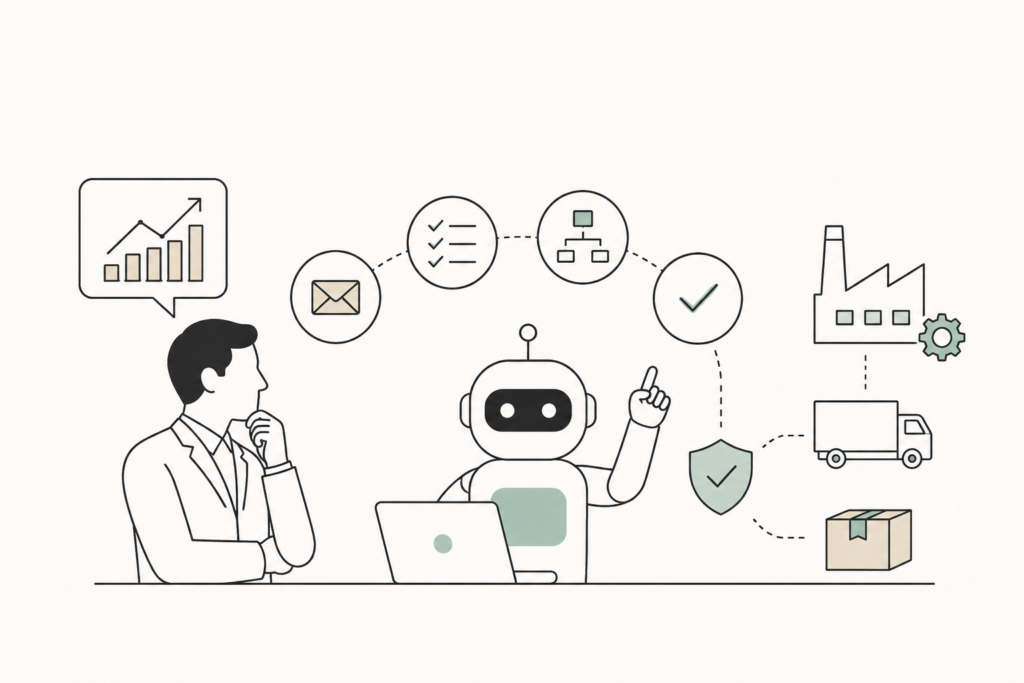
In a nutshell, think of Agentic AI as a system where AI doesn’t just answer requests. It receives goals, creates a plan, chooses actions, and completes tasks through specialized AI agents.
Then what? Agentic AI sounds great, why won’t it sell? I mean, which supply chain leader wouldn’t want an AI agent that detects shipment delays, negotiates alternatives, updates ERP systems, and alerts customers before humans even notice the issue?
Well, on a demo screen Agentic AI looks just magical. But Inside a buying committee meeting it has to face some complex questions. This is where the real battle begins.
So, what is stopping Agentic AI from being sold?
Picking an example of one of my clients selling Ai-powered Supply Chain Optimisation to Manufacturing companies.
Imagine this: You are a Director of supply chain in a mid-size medical device manufacturing company. Every month, your team handles about 500 Purchase Order Confirmation. And considering as per the recent reports, a significant percentage of purchase orders don’t move straight through. They go through changes, clarifications, and exceptions, this is your “Day in a Life of a Director of Supply Chain:
- PO receives → sits in the inbox (30 – 60 mins).
- Buyer checks → finds mismatch (5 mins work)
- Email vendor → waits for reply (1- 3 hours)
- Vendor responds incomplete → follow-up (another 1- 2 hours delay)
- Internal approval needed → sits in queue (30- 90 mins)
- Final confirmation → 5 mins work.
And remember, this is not one person struggling with emails. You already have a three-person team doing this every single day. Each person can process only 12–18 POs. But, your backlog keeps growing, suppliers keep waiting and of course, the production team wants answers faster.
Then an Agentic AI company walks in: “What if this entire monthly workload could be cleared automatically?”
Now, the Agentic AI approves every PO just by looking at the vendor confirmation through emails. And gives a go to the workflow. But in the real world, there is always an obstacle that doesn’t look like one. In this case the AI doesn’t know later that day the same supplier texted the VP saying there will be a slight delay. But it’s too late, the production has already begun. Well, AI is faster, therefore better. The agent did exactly what it was trained to do. It checked the purchase order, matched the confirmation and approved the workflow. Technically, it was right. But operationally, it missed the bigger picture.
There is a reason each PO confirmation takes that much time in a supply chain workflow. Because one wrong PO means the disruption of the entire production line, the logistics and revenue loss. In medical device manufacturing, it means regulatory violations, enquiries, fines and possible backfire for the business itself. Enterprise workflows are not slow because people are inefficient. They are slow because every delay carries hidden business context.
AI makes logical decisions without business judgment.
Your AI may actually solve this problem. But before enterprises believe that, they need something else first: trust. Because many enterprises have already learned this lesson from early automation projects.
The actual problem is enterprise buyers already know your AI will work. Irony is, that’s exactly the problem.
The problem is usually not that enterprises don’t believe your AI works. Because a bad workflow moving slowly creates friction. But a bad workflow moving at AI speed creates damage. Isn’t it amazing and terrifying simultaneously?
This is not a hypothetical concern. Companies have already experienced this lesson.
The real opportunity was not simply reading supplier emails faster. It was understanding why purchase orders needed constant chasing in the first place.
Manufacturing workflows are full of invisible operational knowledge:
- Duplicate vendor records.
- Different item codes across systems.
- Manual overrides nobody documented.
- Exceptions employees remember because they have dealt with the same supplier for five years.
An AI agent sitting on top of this environment does not stop and ask if this is how the process should work?
And that brings us to the real reason what is stopping Agentic AI from being sold.
You are not asking enterprises to buy software anymore. You are asking them to trust software with decisions that used to sit with their people. And that is why trust became the real sales problem.
Let’s enter the old world. The SaaS world.
Now, you might ask: But companies have trusted software for decades. Isn’t that how today’s tech giants were built?
True. But there is one difference. The SaaS companies sold for the last 20 years and the AI agents companies are selling today are not playing the same role.
Before software started taking the wheel, let’s look at the world where it happily sat in the passenger seat.
The first thing that SaaS promises in comparison to Agentic AI is a simple relationship: it had a human standing between the software and the outcome. Simply it means, your people stay in control. We just make them faster.
People bought subscriptions to platforms like Hubspot and Salesforce and put a human in charge to fix the workflow. If it goes wrong, the VP knows who did it.
SaaS transformed businesses by bringing structure, visibility, and automation. However, those systems were not built to think like humans. Then Agentic AI arrived with a different promise: What if software did not just organize the work? What if software could think through it and act on it?
In SaaS, the hardest question was usually: Why should I choose your software over another software?
In Agentic AI, the first question happens much earlier: Should software be allowed to do this job in the first place?
Selling SaaS has always been earning attention because there were a lot of them. Selling Agentic AI is about earning trust those SaaS had among the decision makers.
5 key things to understand to sell Agentic AI to buyers like CXOs.
Previously the equation was: Software + Human = Faster Human.
The current equations is: Agentic AI + Workflow = An Intelligent labour
Well, that’s what you are going to sell.
But, how do you sell a worker made of software?
Before that, let’s meet who guards the gate. Here’s the “map of the marketplace and the buyers.”
SMB: One simple gate. CEO/Owner. They will ask: Will this save me time or money?
Mid-Market: Two gates. The business leader (VP of supply chain, finances or operations) owns the pain. CIO owns the risk.
Enterprise: Gates- Multiple. Efforts- Continuous. Deal closure – measured in months. CIO wants control. CISO wants safety. Legal wants accountability. Finance wants ROI. Procurement wants leverage.
1: Earn your way through pilots.
You shouldn’t barge in and ask the VP his car to drive. Be polite and ask “let me drive in the parking lot, first” or prepare to be humbled by the consequences.
Earn it first. How? Of course, thorough pilots. Your biggest advantage is that enterprises have some belief in Agentic AI. They just want to know if it understands their roads. Utilize it through Pilot release. Start with controlled pilots. Pick one workflow, prove accuracy, build confidence, then expand the level of autonomy.
2: Sell Guardrails Before Capabilities:
Do not start with Our agent can co X, Y & Z. “Because enterprises love to ask, What if all your X, Y, & Z fails?”
You already built what they want. Show them
- Approval of workflows
- Audit trails
- Permission controls
- Human escalation
- Compliance
3: Sell Business Outcomes
This is where the real sales begin. Because, each buyer had different ROI.
CIO ROI:
- fewer manual dependencies
- scalable systems
Business leader ROI:
- faster workflows
- higher capacity
CFO ROI:
- lower operational cost
- productivity gain
CISO/legal ROI:
- reduced uncontrolled risk
4: Understand the business context.
Do not confuse them with your technical multi-agent orchestration layers. The CIO might understand. But the finance head doesn’t and has different questions.
Sell: We reduce supplier confirmation delays by 60%. Because, buyers don’t care how intelligent the agent is. They care which business bottleneck it makes disappear.
Bottomline:
For decades, software companies asked businesses for a seat inside their workflow. Agentic AI is asking for something much bigger. It is asking for permission to make decisions inside those workflows. And permission is never given because someone claims they are intelligent. It is earned.
The winners of this next AI era won’t be the companies shouting about the most powerful agents or the highest automation percentages. They will be the companies that understand the simple truth: Before you ask enterprises for the driver seat, prove you understand their roads.
————
Selling to a CXO was never about explaining how powerful your AI is. You have to answer the question silently sitting behind every buying conversation: Elephant Edge helps AI founders prepare for that conversation.
Need someone who knows these roads?
Let’s map your Agentic AI GTM journey.
Schedule a Quick Call With Our Fractional VP of Sales.
Win Your First $1M in US Market
Effective Sales Execution: The Enormous AI Advantage for CEOs of Small Sales Teams
It’s 9 PM and you’re still in the CRM. Following up on a proposal your...
From Chaos to Clarity: 3 Things AI Will Do for SMB Revenue Teams
There’s an awkward stage in the life of an SMB. You’re doing $3 million, maybe...
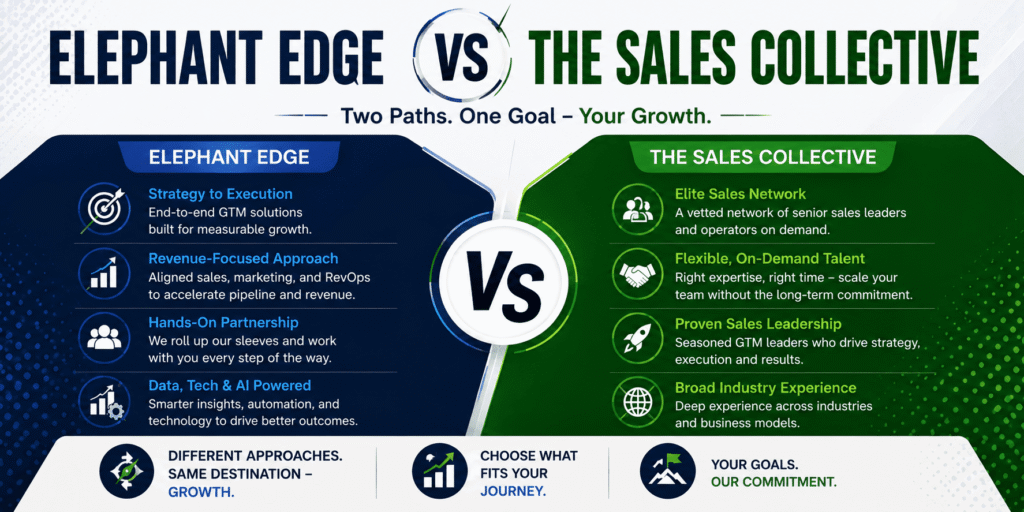
Elephant Edge vs The Sales Collective
Overview: Optimizing Your Sales Team vs Building Your Sales Engine Most companies believe growth problems...
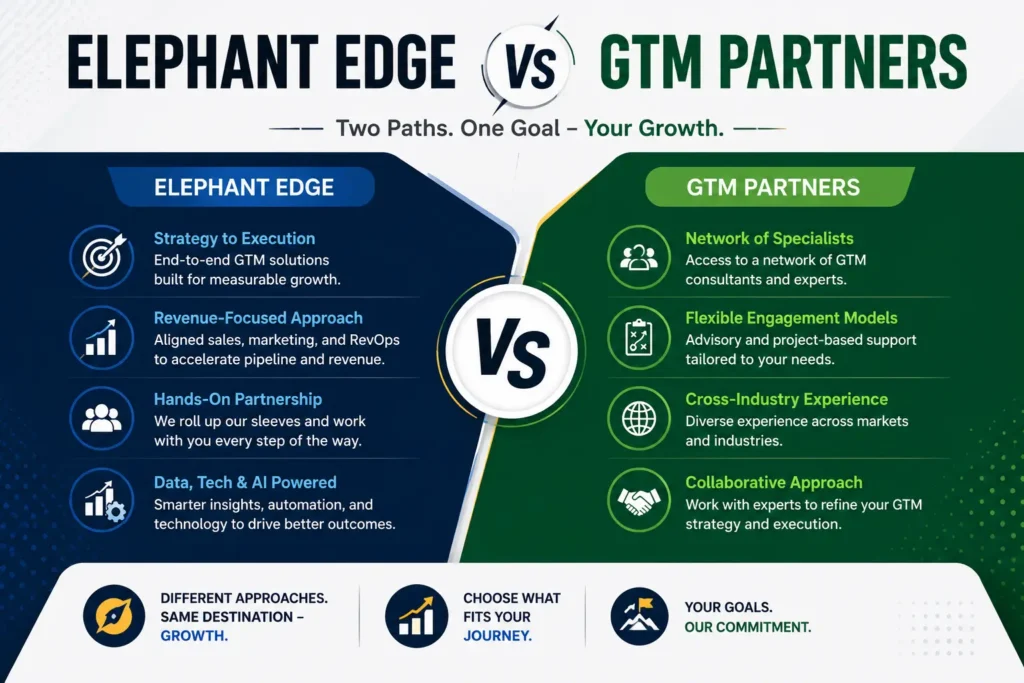
Elephant Edge vs GTM Partners
Overview: GTM Transformation vs Building Your First Revenue Engine Every growing technology company eventually reaches...
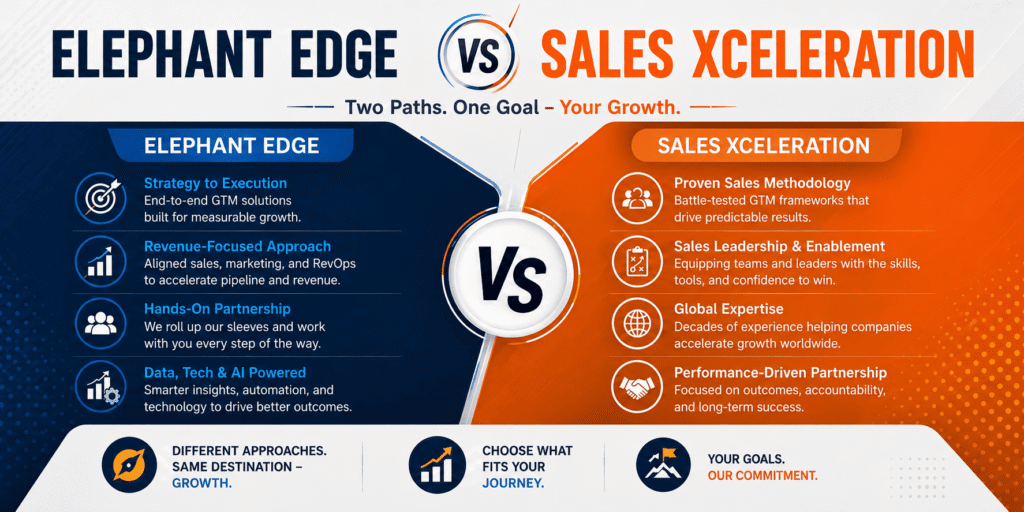
Elephant Edge vs Sales Xceleration
Overview: Managing Your Sales Organization vs Building Your US Revenue Engine Every company reaches a...
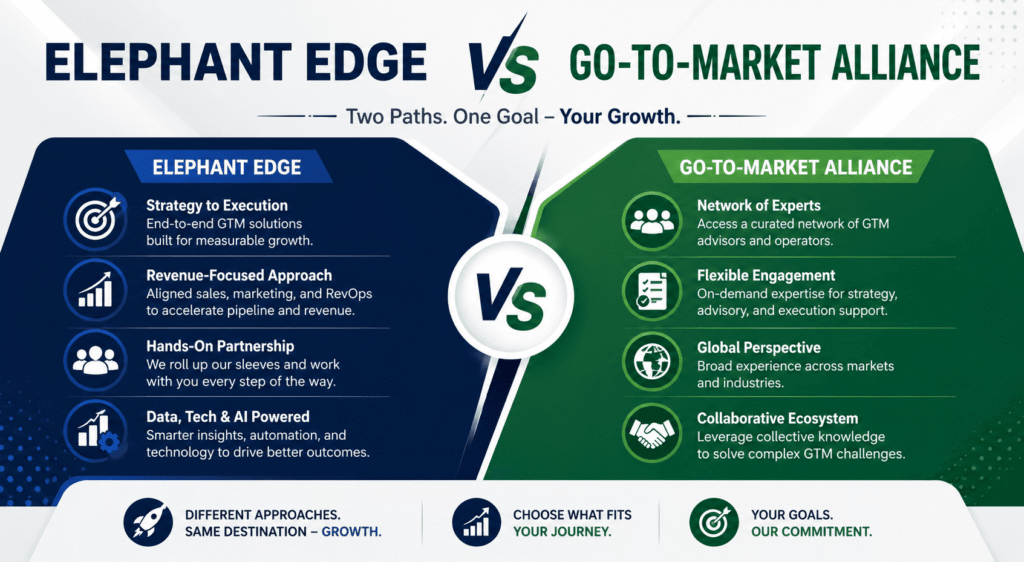
Elephant Edge vs Go-to-Market Alliance
Overview: Learning GTM vs Building Your GTM Engine Every technology company eventually faces the same...